
Future of Work

Why More Professionals Are Choosing Solopreneurship

Why more professionals are choosing solopreneurship is not simply about leaving traditional employment. It is about gaining greater control over how they work, earn, create value and prepare for an increasingly uncertain professional future.

Expertise can help you start. Repeatable business systems are what make independent work more resilient, consistent and sustainable.
Career resilience Independent work Business systems
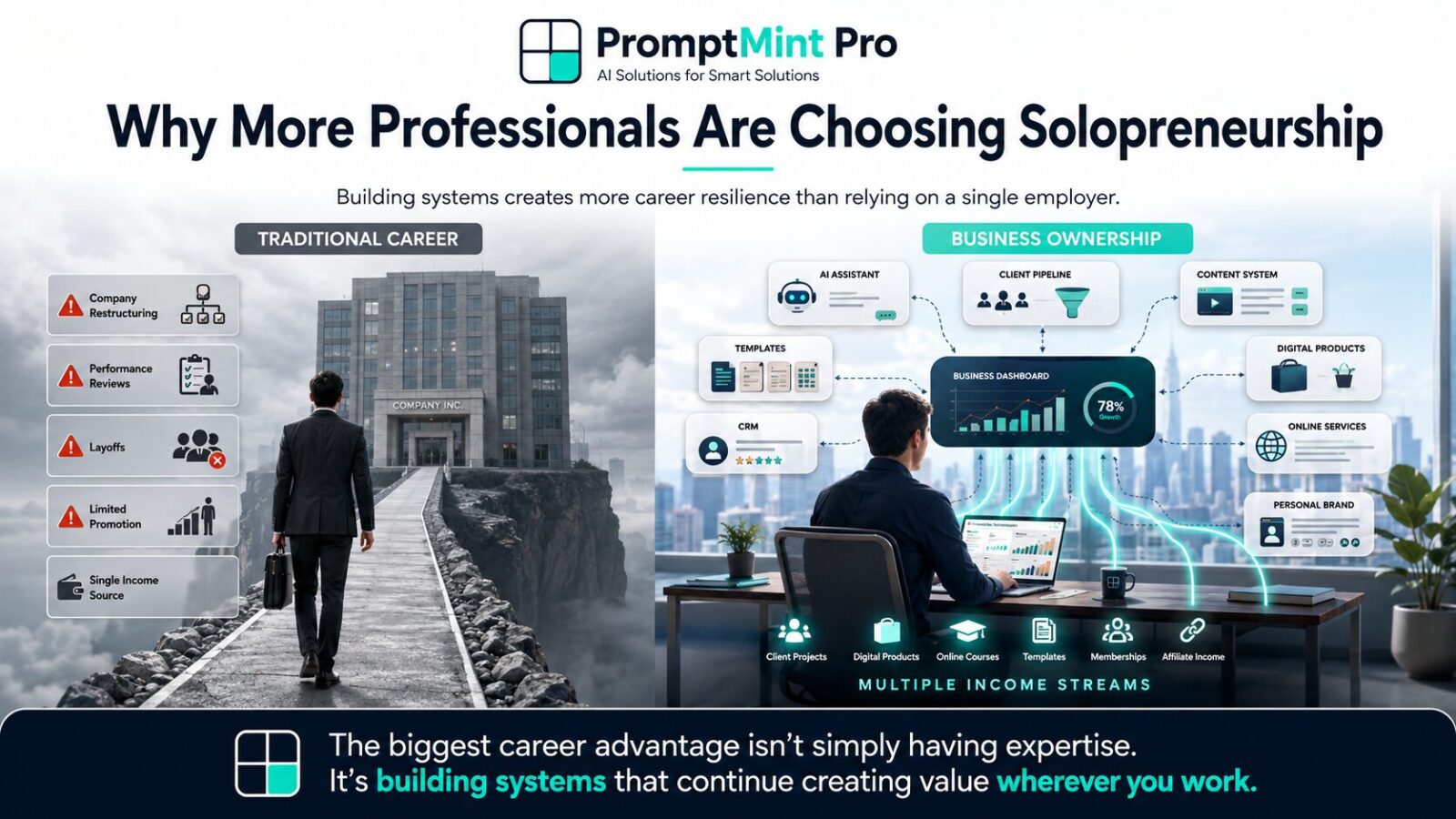
Professional moving from a traditional career toward a solopreneur business supported by AI tools and repeatable business systems.
More professionals are building transferable skills, independent income opportunities and systems they can control.
The Changing Career Landscape

Why Traditional Careers Feel Less Predictable

Traditional employment still offers opportunity, structure and valuable experience. What has changed is the level of certainty professionals can reasonably expect from a single employer or job title.
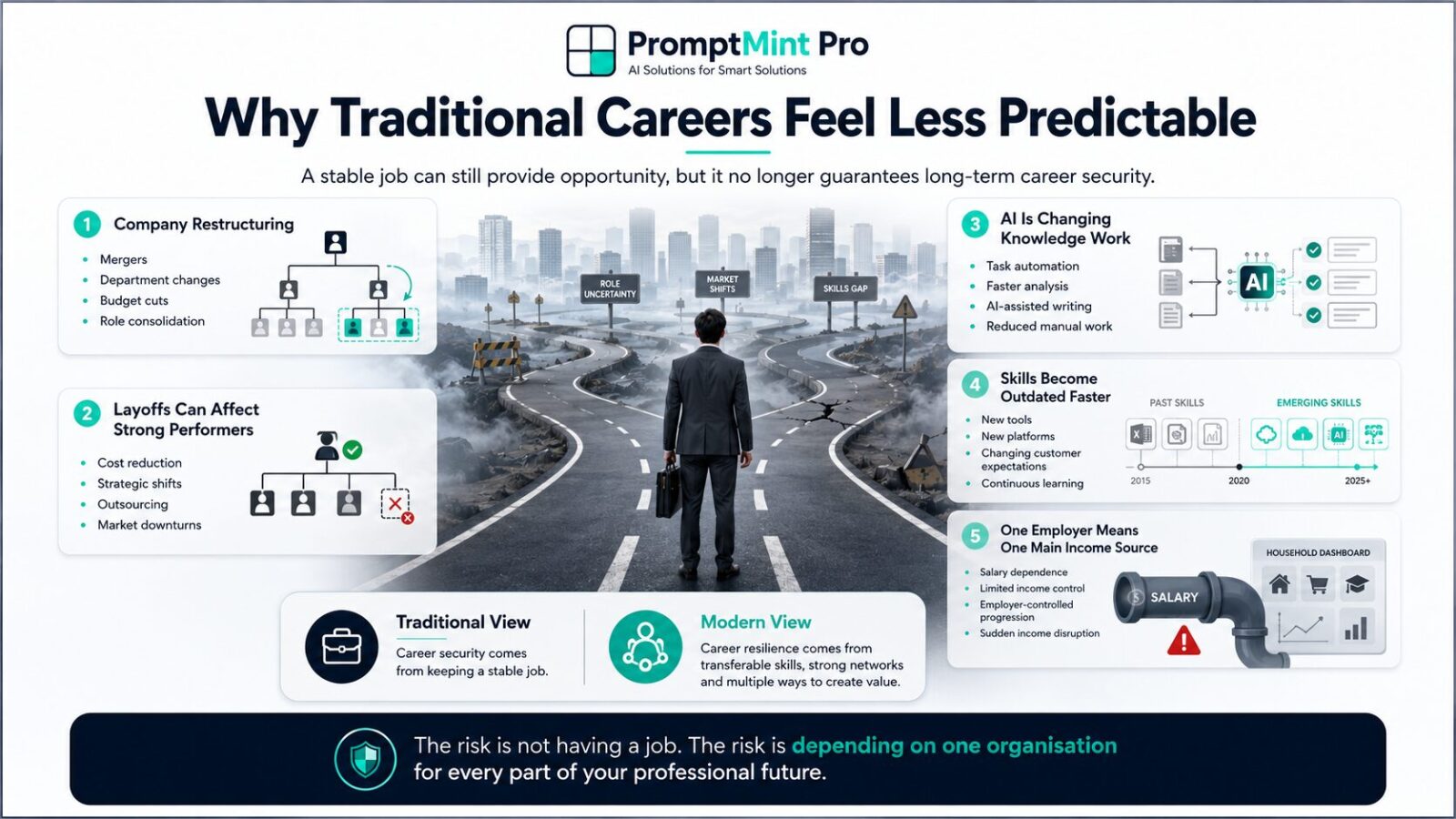
Professional facing an uncertain traditional career path shaped by restructuring, layoffs, artificial intelligence, changing skills and dependence on one employer.

Traditional employment has not suddenly become irrelevant. Millions of professionals continue to build meaningful and successful careers inside organisations.

What has changed is the amount of security attached to that path. A strong performance record does not always protect someone from restructuring, outsourcing, budget reductions or a change in company strategy.

A valuable role can disappear because the organisation changes, even when the professional performing it has done nothing wrong.

Artificial intelligence is also changing the shape of professional work. Tasks that once required hours of manual research, writing, analysis or administration can increasingly be completed faster with AI assistance.

This does not automatically make experienced professionals unnecessary. It changes where their value comes from. The advantage is shifting from completing routine work to applying judgment, managing complexity, making decisions and designing better systems.

Skills are also becoming outdated more quickly. Expertise developed several years ago may no longer be enough without continuous learning, experimentation and adaptation.

A traditional career often ties several important parts of a professional's future to one organisation:
  • Salary and financial security
  • Professional identity
  • Access to networks
  • Career progression
  • Training and development
  • Future opportunities

When all of these depend on one employer, a single organisational decision can affect everything at once.

This is one reason solopreneurship is becoming more attractive. It gives professionals a way to develop skills, relationships, assets and income opportunities that remain useful beyond one company or job title.

Key Insight

Employment can still be valuable. The more important question is whether your entire professional future depends on one organisation.
Professional leaving the traditional corporate career path to build an independent solopreneur business supported by AI and business systems.
A New Way to Build a Career

The Rise of Independent Work

Modern tools now allow experienced professionals to build and operate small, specialised businesses with far less infrastructure than traditional business ownership once required.
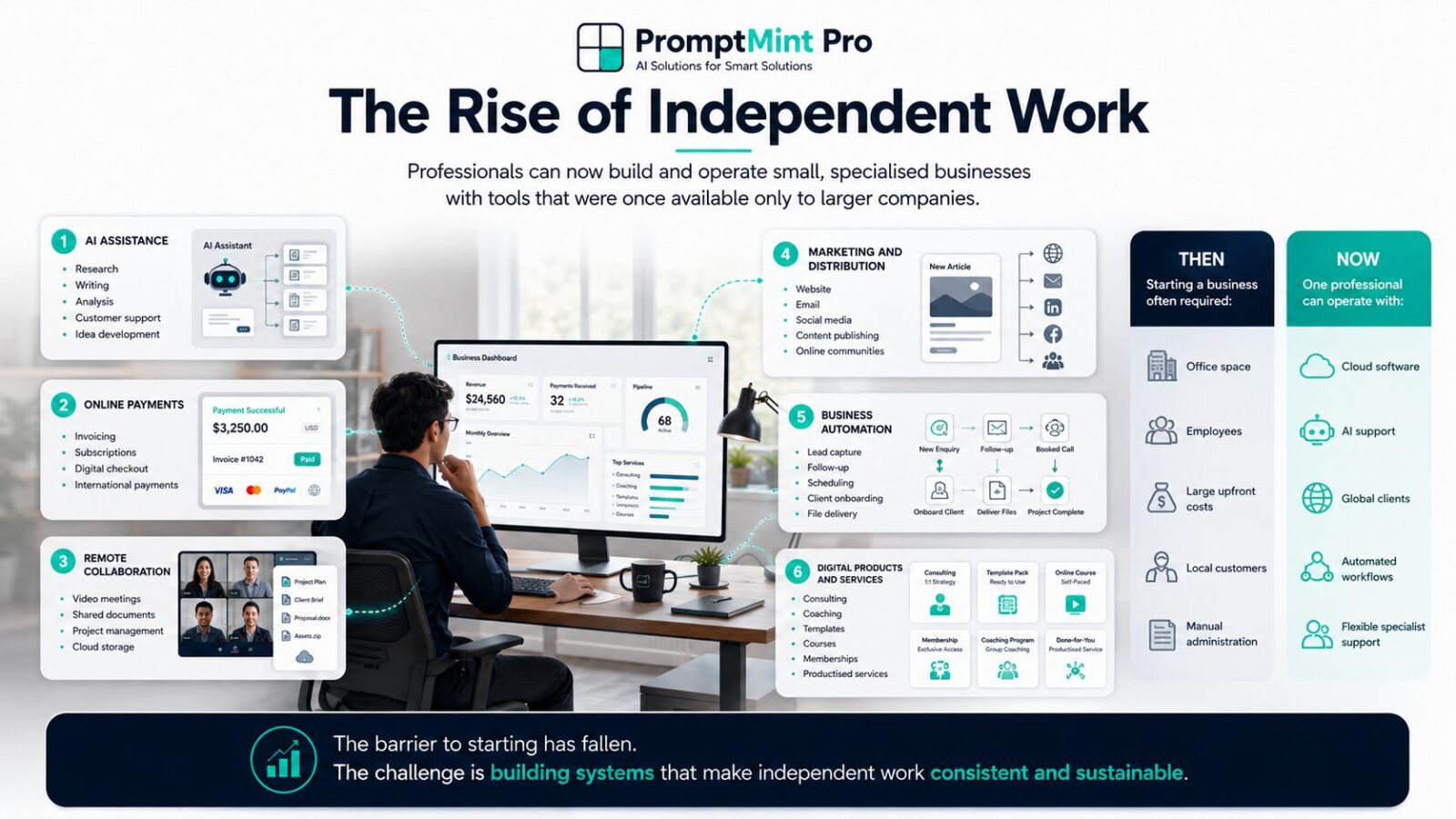
Professional running an independent business using AI tools, digital platforms, online payments, remote collaboration and repeatable business systems.
Independent professionals can now access digital capabilities that were once available mainly to larger organisations.

Independent work is not new. What has changed is how much one capable professional can now build, manage and deliver without a large team or expensive physical infrastructure.

Consultants, freelancers, tradespeople and small business owners have operated independently for generations. Today, however, many professional services can be delivered by one person using a connected set of digital tools.

A consultant no longer needs an office, receptionist and large administrative team to serve clients professionally. A designer can manage projects, collect payments and deliver work online. A coach can schedule sessions, run video calls and provide digital resources through one connected workflow.

A specialist can also package knowledge into templates, workshops, advisory services, productised offers or digital products and reach customers beyond a local market.

Modern platforms have reduced many of the practical barriers that once made independent business ownership difficult:
AI assistance Research, drafting, analysis and idea development.
Online payments Invoicing, checkout, subscriptions and global transactions.
Remote collaboration Video calls, cloud files and shared project workspaces.
Business automation Lead capture, scheduling, onboarding and file delivery.

These tools allow a solopreneur to perform many functions that previously required several employees. They make it possible to launch faster, work with customers across borders and bring in specialist support only when it is genuinely needed.

The Important Limitation

Easier access to tools does not automatically create a sustainable business.

A professional may be able to launch a website, create an offer and begin accepting payments within days. The harder task is building a dependable way to attract leads, convert enquiries, deliver work and maintain consistent income.

This is where many new solopreneurs struggle. They have enough technology to begin, but they do not yet have the business systems needed to operate consistently.

The real opportunity is not simply to become self-employed. It is to use modern tools to build a focused business that can deliver value repeatedly without depending on constant improvisation.

Then
  • Office space and physical infrastructure
  • Employees from an early stage
  • Large upfront operating costs
  • Primarily local customers
  • Manual administration and delivery
Now
  • Cloud software and connected workspaces
  • AI and automation support
  • Access to global customers
  • Flexible specialist assistance
  • Repeatable digital workflows
Key Insight

Technology has made independent work easier to start. Business systems are what make it easier to sustain.

From Skill to Sustainable Business

Expertise Alone Is No Longer Enough

Expertise helps a professional create valuable work. Business systems determine whether that value can be sold, delivered and repeated consistently without exhausting the person behind it.
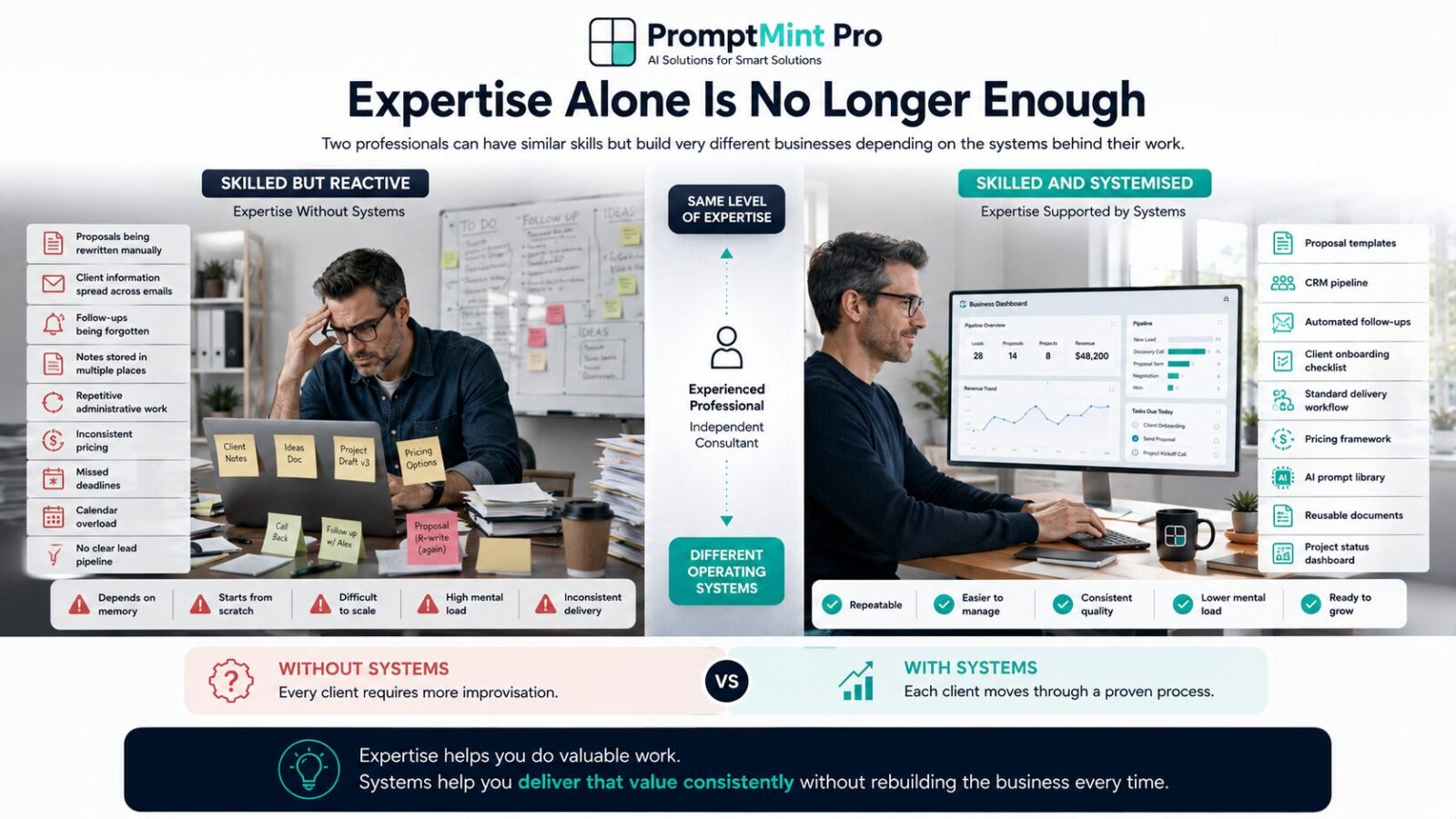
Comparison between two equally skilled consultants, where one relies on memory and manual work while the other uses business systems, templates, automation and repeatable workflows.
Expertise creates value, but business systems determine whether that value can be delivered consistently and sustainably.

Many professionals enter solopreneurship with a major advantage: they already know how to do valuable work. The challenge is turning that expertise into a business that does not depend on constant improvisation.

A consultant understands strategy. A designer understands communication. A coach understands transformation. A specialist understands a problem that clients are willing to pay to solve.

That expertise matters. It is often the reason a client chooses to work with them. But expertise alone does not automatically create a reliable business.

A highly capable professional can still struggle when every part of the business depends on memory, manual effort and decisions that must be made again from the beginning.

Consultant One

Skilled but Reactive

The work may be strong, but almost every project begins from scratch.

  • Rewrites every proposal manually
  • Stores client information across emails
  • Relies on memory for follow-ups
  • Creates a new process for every project
  • Prices similar work differently each time
  • Searches through old files for examples
  • Completes administration late at night
Consultant Two

Skilled and Systemised

The work remains personalised, but the repeatable parts follow a defined process.

  • Uses a lead qualification checklist
  • Follows a documented discovery process
  • Works from proposal templates
  • Uses a consistent pricing framework
  • Runs a client onboarding workflow
  • Uses reusable AI prompts and documents
  • Keeps information in one workspace

The Real Difference Is Operational

The difference between these two consultants is not talent. It is not necessarily effort. It is the operating system behind the work.

Without systems, growth usually creates more complexity. More clients mean more emails, more follow-ups, more files, more decisions and more opportunities for mistakes.

With systems, growth becomes easier to manage because repeatable work already has a defined path. The professional can focus more attention on judgment, relationships, creativity and high-value decisions.

This does not mean every part of a business should be automated. Clients still need empathy, professional attention and human judgment. The goal is to systemise only the work that does not need to be reinvented.

What Expertise Cannot Solve by Itself

01
Lead Pipeline Expertise does not automatically create a steady flow of qualified opportunities.
02
Clear Pricing Strong delivery skills do not remove uncertainty around what to charge.
03
Consistent Follow-Up Good work cannot recover opportunities that disappear through forgotten follow-ups.
04
Protected Capacity Expertise alone does not prevent overload when every new client adds more manual work.
05
Efficient Onboarding New clients still need a clear and repeatable path into the service.
06
Organised Knowledge Valuable experience loses leverage when it remains scattered across files and messages.
07
Repeatable Delivery Quality becomes harder to protect when each project follows an improvised process.
08
Predictable Revenue Professional ability does not automatically produce consistent income.

These are operational problems. They require business systems.

A professional may be excellent at serving clients and still struggle to attract them consistently. They may produce excellent work and still lose time because their files, processes and decisions are scattered.

This is why some highly skilled solopreneurs remain stuck while others with similar expertise build businesses that are easier to operate.

The Better Question
Professional Question

How can I become even better at my profession?

Business-System Question

How can I make the way I attract, serve and retain clients more repeatable?

Both questions matter. Professional expertise improves the quality of the result. Business systems improve the reliability of the process.

Key Insight

Expertise helps you create value. Systems help you deliver that value consistently without rebuilding the business every time.

From Constant Effort to Repeatable Work

Building Business Systems That Create Freedom

The goal is not to automate everything. It is to remove unnecessary repetition so professionals can spend more time applying judgment, building relationships and creating value.
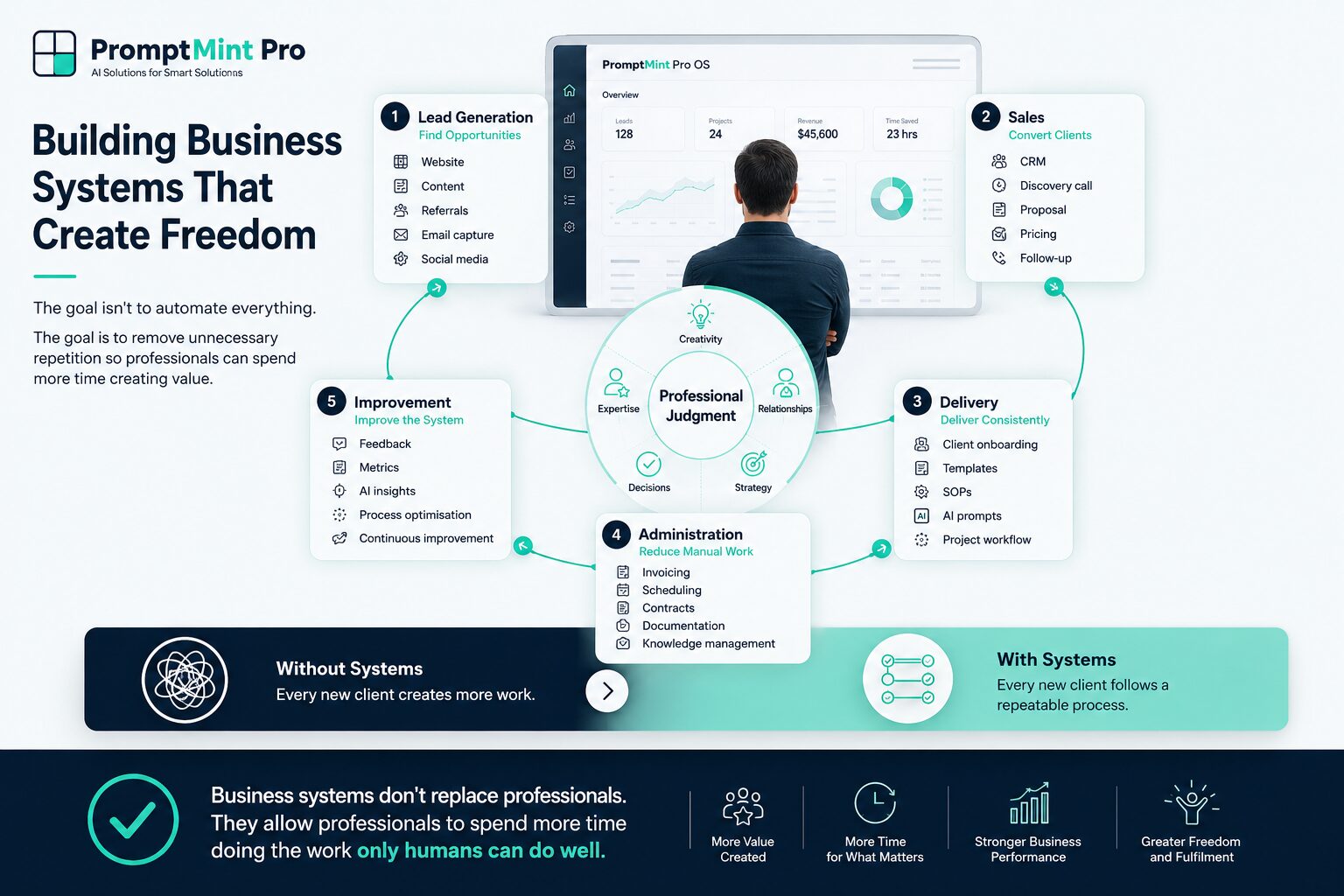
Professional operating a calm and organised solopreneur business through connected systems for lead generation, sales, delivery, administration and continuous improvement.
A sustainable solopreneur business depends less on working harder and more on building systems that handle repeatable work consistently.

Many professionals think business systems exist mainly to make work faster. Their deeper purpose is to make work more consistent, predictable and less dependent on memory.

When every new client requires rewriting the same proposal, repeating the same onboarding steps or searching for the same documents, valuable time disappears into operational work.

Business systems reduce that unnecessary repetition. They create a clear path for routine activities so the professional can spend more time solving client problems and less time managing avoidable administration.

The purpose of a system is not to remove the professional. It is to remove the repetitive work surrounding professional judgment.

Five Systems Behind a Sustainable Solopreneur Business

A reliable independent business usually develops systems across five connected areas. Each system supports a different part of the client journey, but they work best when they reinforce one another.

Lead generation creates opportunities. Sales turns the right opportunities into clients. Delivery produces consistent results. Administration keeps the work organised. Continuous improvement helps the entire business become easier to run over time.

These systems do not need to be complex. A documented checklist, a reusable template or a clearly defined workflow can often create more value than another piece of software.

Systems Protect the Work That Matters Most

Clients still value expertise, empathy, creativity and thoughtful decision-making. These human qualities should not be automated away.

Instead, systems should protect them. When scheduling, follow-up, invoicing, onboarding and routine documentation follow a clear process, the professional has more capacity for the work that requires genuine attention.

The most effective solopreneurs are not necessarily the busiest. They are often the ones whose businesses require fewer unnecessary decisions because routine activities already follow a proven path.

Keep the Human Work Human

Systems should create more space for professional judgment.

The purpose of operational structure is to free the professional to focus on the activities where human experience creates the greatest value.

01
Creativity
02
Professional Judgment
03
Client Relationships
04
Strategic Decisions
05
Problem Solving
Without Systems

Every new client creates more administration, more decisions and more opportunities for inconsistency.

With Systems

Every new client moves through a repeatable process that protects quality and professional capacity.

Key Insight

Business systems do not replace professional expertise. They protect it by allowing professionals to spend more time creating value and less time managing repetitive work.
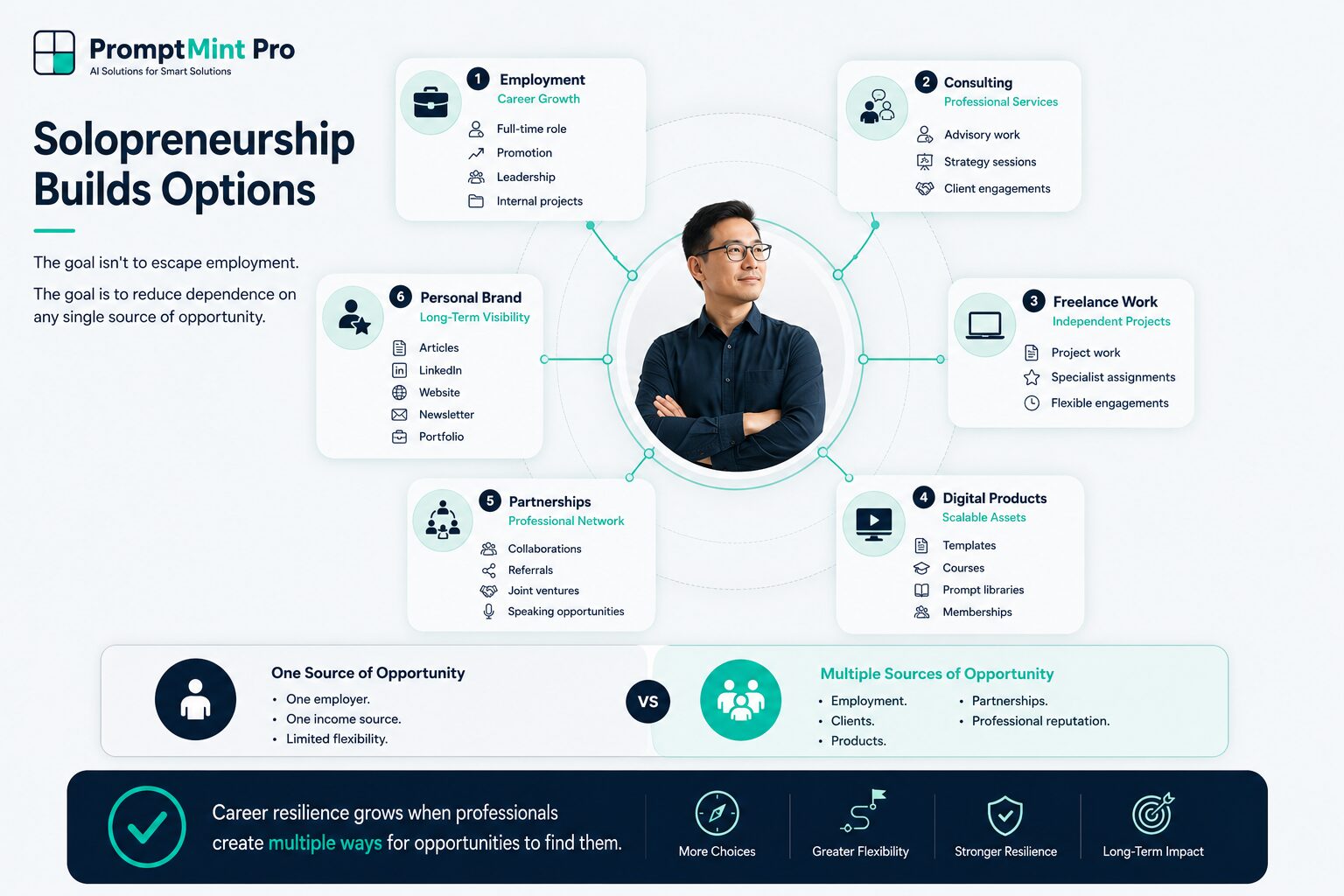
Career Resilience Through Optionality

Solopreneurship Builds Options

The goal is not to escape employment. It is to reduce dependence on any single source of opportunity by building skills, relationships and assets that remain valuable across different career paths.

Professional standing at a career crossroads with connected opportunities including employment, consulting, freelance work, digital products, partnerships and a personal brand.
Solopreneurship is not necessarily about replacing employment. It is about gradually building more professional options.

One of the biggest misconceptions about solopreneurship is that it requires rejecting traditional employment. For many professionals, the real motivation is greater career flexibility and resilience.

Employment remains a valuable career path. It can provide stable income, structured learning, collaboration, mentorship and access to opportunities that may be difficult to create independently.

Solopreneurship does not need to compete with those benefits. Instead, it can add another layer to a professional career by creating additional ways to use expertise and generate opportunity.

A professional with several sources of opportunity is often more resilient than someone whose entire future depends on one role, one employer or one professional identity.

Practical Example

One professional, several career assets

An experienced marketing manager might continue working full time while gradually building independent assets around their existing expertise.

  • Advising selected small businesses
  • Speaking at industry events
  • Publishing educational content
  • Selling digital templates
  • Building a professional newsletter
  • Taking on occasional consulting work

None of these activities require an immediate departure from employment. Instead, they create experience, visibility, trust and professional assets that can remain useful if the person's circumstances or priorities change.

The Value Is in Having a Choice

Over time, these assets can create greater flexibility. A professional may eventually decide to remain employed, move into consulting, build a specialised practice or combine several kinds of work.

Continue in full-time employment
Reduce working hours gradually
Move into consulting
Build a specialised practice
Create digital products
Combine multiple income sources

The important point is not that every professional should leave employment. It is that they have enough assets, relationships and capabilities to make a deliberate choice rather than being forced into one path.

Career resilience increasingly comes from having multiple ways to create value. A strong professional reputation, useful content, trusted relationships and repeatable offers can continue producing opportunities even when one role or employer changes.

For many professionals, solopreneurship is therefore not an alternative to employment. It is an additional layer of career security.

One Source of Opportunity
  • One employer
  • One main income source
  • Employer-controlled progression
  • Limited flexibility when circumstances change
Multiple Sources of Opportunity
  • Employment and professional advancement
  • Clients and independent projects
  • Digital products and reusable assets
  • Partnerships and professional reputation
Key Insight

The strongest careers are often built on multiple sources of opportunity. Solopreneurship can create additional career security without requiring professionals to reject employment.

Building for Continuous Change

The Future Belongs to Professionals Who Build Systems

Technology will continue changing. Well-designed business systems help professionals adapt without rebuilding the way they work every time a new tool, platform or market shift appears.
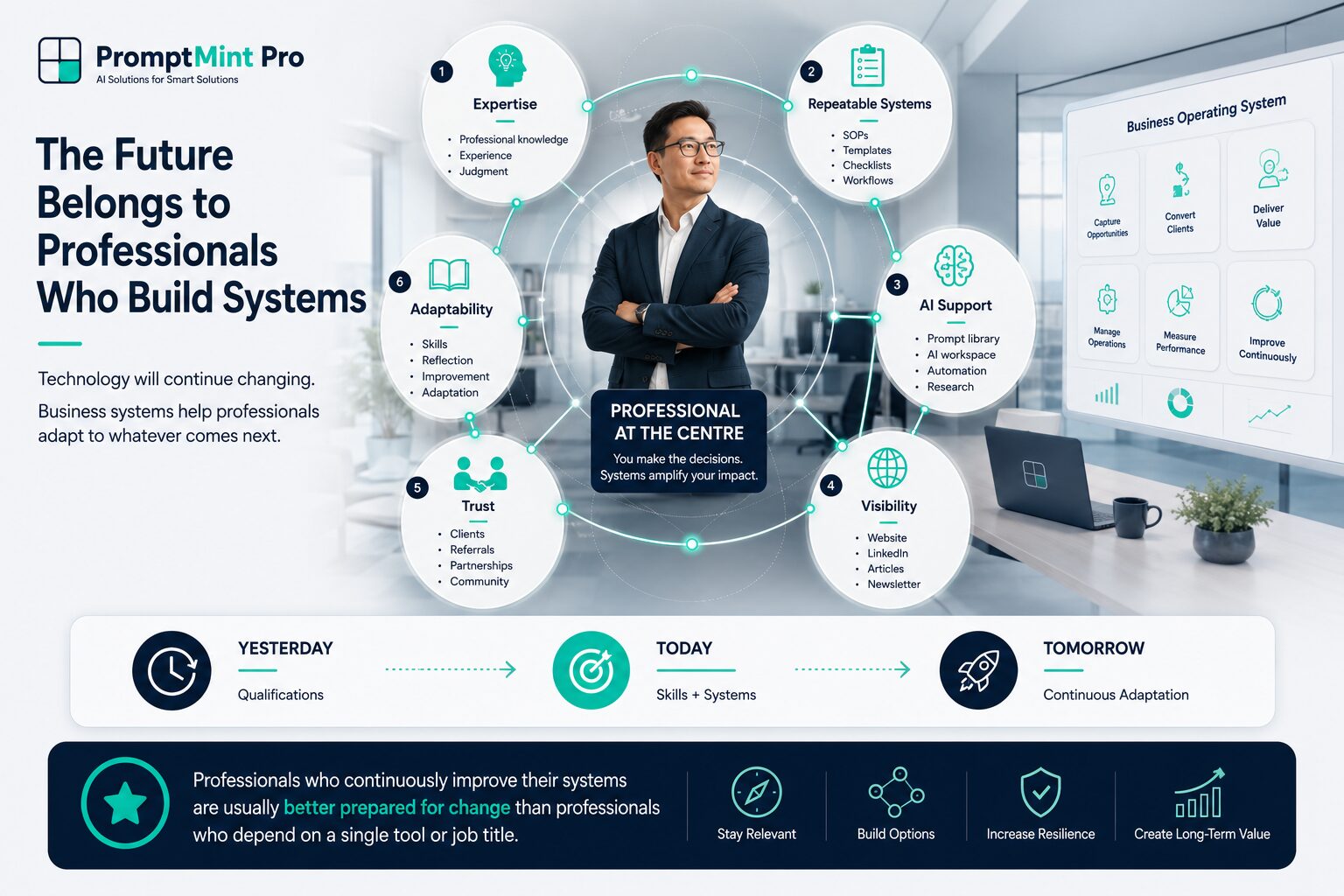
Modern professional leading a connected business operating system that combines expertise, AI assistance, visibility, relationships and repeatable workflows.
Technology changes quickly. Well-designed systems help professionals adapt regardless of which tools become popular next.

Predicting every change in the future of work is difficult. Building the ability to adapt is far more valuable.

New AI models will emerge. Software platforms will evolve. Entire industries will adopt different methods of working, delivering services and communicating with customers.

Professionals who depend too heavily on one tool may need to reconstruct their workflows every time the technology changes. Professionals who understand the system behind the tool can adapt more easily.

A business system defines the outcome, the steps, the information required and the standard that must be met. Individual technologies can then be replaced without losing the structure of the work.

The Tools Change. The Workflow Remains.

A stable process can survive changing technology.

Different professionals may replace the software they use, while preserving the underlying process that creates value.

Consultant Replaces one AI assistant while keeping the research and advisory workflow.
Designer Adopts new creative software while preserving the client briefing and review process.
Coach Changes scheduling platforms while keeping the onboarding and session workflow.
A Better Way to Think
Tool-Focused Question

Which AI tool should I learn next?

System-Focused Question

How can I improve the system that helps me create value?

Systems Make Improvement Transferable

When professionals improve a system, the benefit can remain useful even after the software changes. A better proposal structure, lead qualification process or client delivery workflow is not tied to one application.

This creates a more resilient business because improvements become transferable across technologies. Tools support the work, but the system determines how the work creates value.

The strongest professionals are rarely the ones chasing every new platform. They are usually the ones who continuously improve how they attract clients, organise knowledge, deliver services and make decisions.

Technology will keep changing. Professional expertise will keep evolving. Business systems provide the stable foundation that allows both to grow together.

How Career Advantage Is Changing
01
Yesterday Qualifications
02
Today Skills and Systems
03
Tomorrow Continuous Adaptation
Key Insight

AI tools will change. Well-designed business systems help professionals adapt to whatever comes next without rebuilding their work from the beginning.

Article Summary

Key Lessons to Remember

Five practical ideas professionals can use to build greater resilience, create more career options and prepare for a changing future of work.
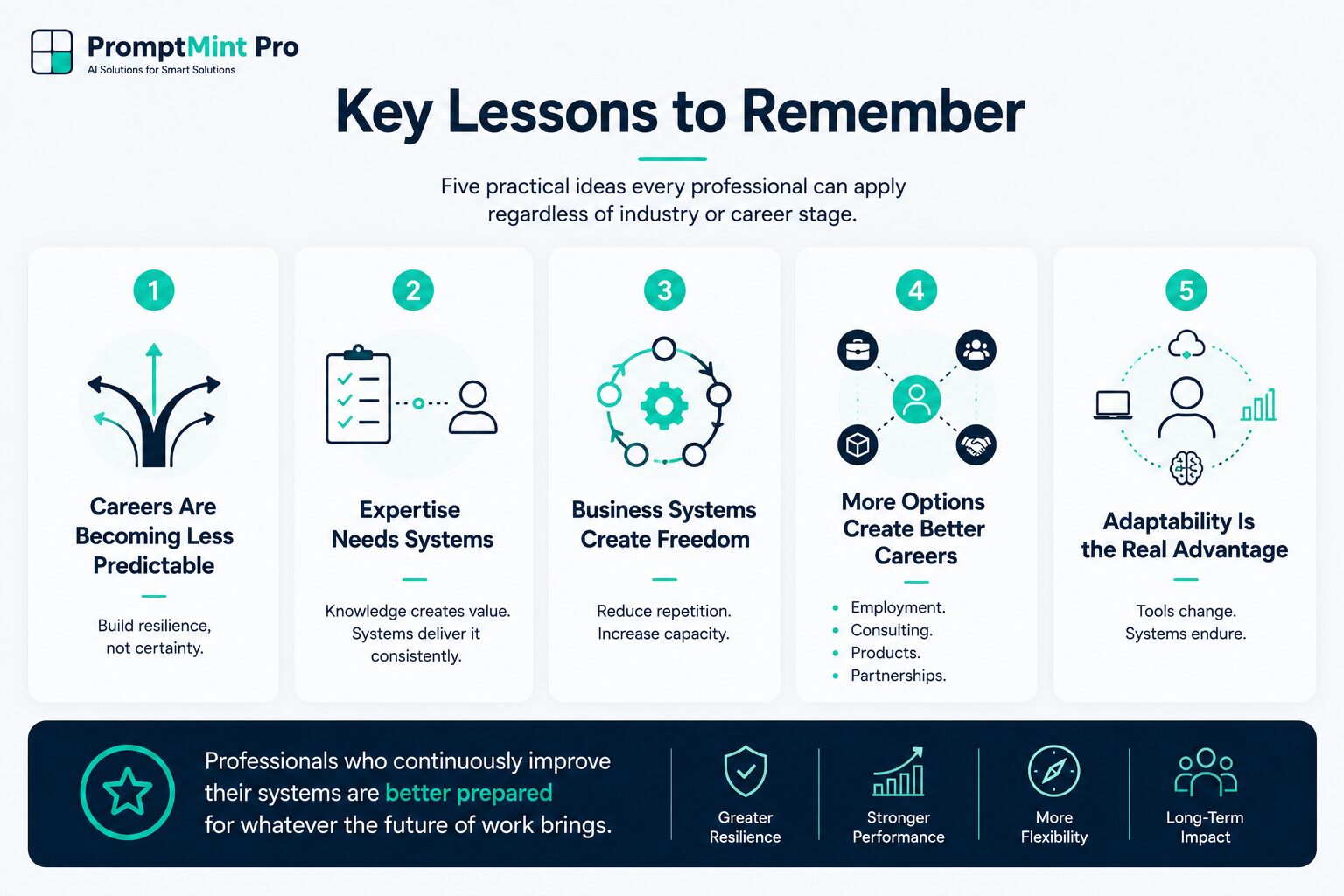
Editorial infographic summarising five key lessons about solopreneurship, business systems, career resilience and the future of work.
The future of work is less about choosing between employment and entrepreneurship, and more about building an adaptable professional operating system.

The most useful response to uncertainty is not to chase every new trend. It is to build a career that becomes more adaptable, systemised and resilient over time.

Solopreneurship is becoming more attractive because modern professionals can create several ways to use their expertise instead of depending entirely on one employer, one role or one source of opportunity.

The lessons below summarise the practical ideas that matter most, whether someone remains employed, builds a side business or moves fully into independent work.

01
Career Resilience

Career Stability Is Changing

Traditional employment still provides valuable opportunities, but professionals can no longer assume that one role or organisation will provide permanent certainty.

  • Build transferable skills
  • Develop relationships beyond one employer
  • Create assets that remain useful across roles
02
From Skill to Business

Expertise Is Only the Starting Point

Professional knowledge creates value, but it does not automatically create a reliable lead pipeline, consistent pricing or organised client delivery.

  • Expertise improves the result
  • Systems improve the process
  • Both are necessary for sustainable growth
03
Operational Freedom

Business Systems Create Capacity

Templates, checklists, workflows and documented processes reduce repetitive decisions and protect time for higher-value professional work.

  • Reduce unnecessary repetition
  • Improve consistency
  • Protect professional attention
04
Career Optionality

More Options Create Stronger Careers

Solopreneurship does not always replace employment. It can add new pathways through consulting, freelance work, partnerships, digital products and a visible professional reputation.

  • Employment can remain one useful option
  • Independent assets create flexibility
  • Multiple opportunities reduce dependence
Final Thought

The future may not belong to the professionals who simply work the hardest. It is more likely to favour those who combine expertise, business systems, continuous learning and thoughtful use of AI to remain valuable as the world of work changes.

Frequently Asked Questions

Frequently Asked Questions

Thinking about becoming a solopreneur or building a more resilient career? These answers address the questions professionals ask most often.

Is solopreneurship replacing traditional employment?

No. Traditional employment continues to offer valuable benefits such as stable income, structured career development, collaboration and mentorship.

For many professionals, solopreneurship is not a replacement for employment. It is an additional career option that creates greater flexibility and resilience.

Why are more professionals choosing solopreneurship?

More professionals are seeking greater control over how they work, who they work with and how they generate income.

Modern technology, AI and digital platforms have also reduced many of the barriers to building an independent business.

Do I need to quit my job to become a solopreneur?

No.

Many professionals begin by building consulting work, freelance projects, educational content or digital products while remaining employed. This allows them to test ideas before making larger career decisions.

What is the difference between a freelancer and a solopreneur?

Freelancers typically sell their time or specialist skills on individual projects.

Solopreneurs usually build repeatable business systems, defined offers, documented workflows, pricing frameworks and reusable assets that make the business easier to scale and manage.

Is expertise enough to build a successful business?

Expertise is essential, but it is rarely enough by itself.

Professionals also need systems for attracting clients, pricing services, following up, delivering consistent work and managing administration.

What business systems should I build first?

Most new solopreneurs benefit from building systems in this order:

  1. Lead generation
  2. Sales and follow-up
  3. Client onboarding
  4. Service delivery
  5. Administration

Simple checklists, templates and documented workflows are often enough to get started.

How does AI help a solopreneur?

AI can accelerate research, writing, planning, documentation, proposal drafting and repetitive administrative work.

Its greatest value comes when it supports an existing business system rather than replacing professional judgment.

Can solopreneurship provide more career security?

It can create greater career resilience by reducing dependence on a single employer or income source.

However, it also requires professionals to take responsibility for sales, marketing, delivery and continuous improvement.

Is solopreneurship suitable for everyone?

No.

Some professionals prefer the structure and stability of employment, while others enjoy building independent businesses. Both are valid career choices.

The best path depends on personal goals, risk tolerance and preferred working style.

What is the biggest mistake professionals make?

Many professionals focus on websites, branding or AI tools before validating their offer and building reliable business systems.

Start by solving a real customer problem consistently. The tools should support the system—not become the system.

Next Step

Whether you remain employed, build a side business or become a full-time solopreneur, the most valuable starting point is understanding which part of your business or career needs the most improvement first. The next section will help you identify that bottleneck.

Every professional’s situation is different. Some already have strong foundations, while others may have hidden gaps that only become visible when industries or technologies change.

Before deciding what to learn next or whether to build independent income, it helps to understand where you stand today.

Free Career Assessment

How Future-Ready Is Your Career?

The future of work is changing faster than most professionals expect. Rather than guessing how prepared you are, use the PromptMint Career Resilience Diagnostic to take a structured look at the strengths, risks and gaps in your professional foundation.

The free diagnostic is delivered as a practical Google Worksheet you can copy and complete at your own pace. It helps you assess adaptability, AI readiness, professional visibility, business skills and career optionality.

Complete the self-assessment in approximately 15 minutes.
Scroll to Top