Future of Work Singapore labour market · Career resilience
8-minute read Updated July 2026 Evidence-based analysis

Why Are Degree Holders Being Retrenched?

For decades, earning a university degree was widely regarded as one of the safest investments in a person's future. It promised access to better careers, higher salaries and greater job security.

So why are degree holders being retrenched despite their education and professional experience?

Recent Singapore labour market data suggests the answer has less to do with qualifications losing value—and far more to do with how organisations are redesigning work, adopting new technologies and redefining the skills they need.

Professional degree holder observing an AI-enabled workplace transformation in Singapore
A university degree still opens doors, but long-term career resilience increasingly depends on adaptability, AI literacy and continuous learning.

The qualification is not changing as quickly as the workplace is

Degree holders are often concentrated in professional, managerial, financial and knowledge-intensive roles. These positions can be particularly exposed when organisations restructure departments, merge responsibilities or redesign workflows around new technology.

The better question is not whether a degree still has value. It is whether the knowledge, experience and working methods attached to that qualification continue to solve problems employers and customers consider important.

The real question is whether the way you create value at work is evolving as quickly as the workplace itself.

  • Adaptable skills
  • AI literacy
  • Business systems
  • Multiple income streams

Source used in this analysis

Singapore Ministry of Manpower — Labour Market Report, First Quarter 2026

The official quarterly report covers employment, unemployment, vacancies, retrenchment incidence and re-entry into employment. It found that retrenchments rose slightly but remained within non-recessionary norms, with business reorganisation and restructuring identified as the dominant reasons for retrenchment.

Read the official report
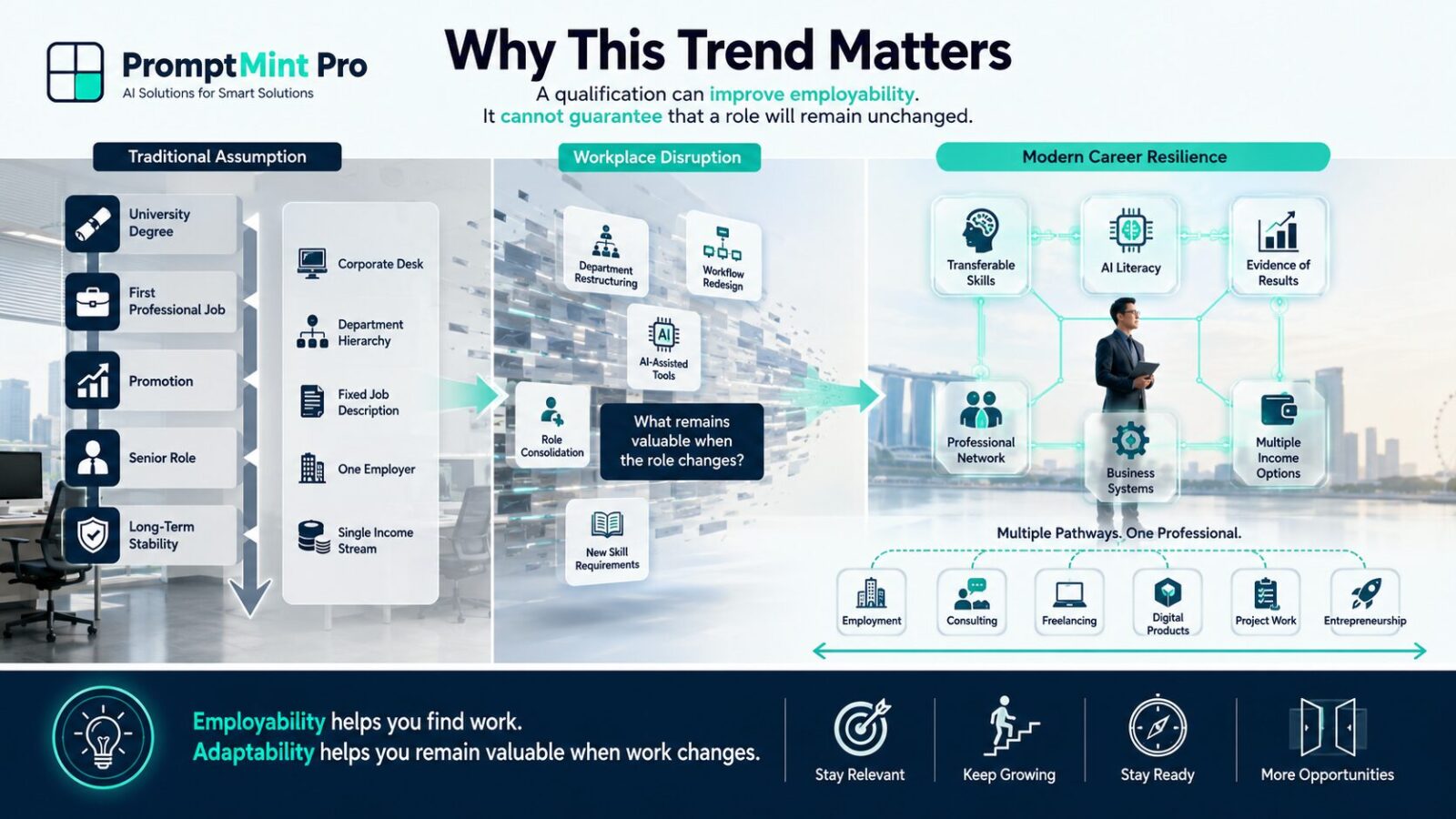
Why This Trend Matters

A Degree Can Improve Employability. It Cannot Freeze a Job in Place.

The rise in retrenchments among degree holders matters because it challenges a deeply held assumption: that formal education provides lasting protection from career disruption.

A university degree continues to improve access to many professional occupations and remains associated with strong employment outcomes. However, it cannot guarantee that a particular department, job description or way of working will remain valuable indefinitely.

Many degree holders work in professional, managerial, financial, technical and knowledge-intensive roles. These positions often sit within functions that organisations can reorganise, consolidate or redesign when technology, customer expectations and business priorities change.

Degree holder moving from a traditional career ladder toward adaptable skills, AI literacy and career resilience
Career security is shifting from dependence on one qualification and one employer toward adaptable skills, useful systems and multiple ways to create value.

The traditional model of career security is becoming less reliable

The old model assumed that education would lead to employment, promotion and long-term stability. That pathway still exists, but it has become less predictable as roles are reorganised and required skills change.

The emerging model requires continuous learning, adaptation and, at times, professional reinvention. This does not mean everyone must leave employment or become an entrepreneur. It means professionals need forms of security that can move with them.

Traditional assumption

Education Employment Promotion Stability

Emerging resilience model

Education Continuous Learning Adaptation Reinvention Resilience

  • A role depends heavily on processes the organisation is simplifying.
  • Expertise is difficult to connect to measurable business outcomes.
  • Responsibilities can be redistributed across teams or technology.
  • Skills have not evolved alongside the tools now used in the role.
  • Professional identity depends on one employer and one job function.
  • Income depends entirely on a single organisation or employment stream.

Sources and further reading

Ministry of Manpower — Labour Market Report, Q1 2026

Singapore's official report found that retrenchments rose to 3,830, while the overall incidence remained low and within non-recessionary norms. The increase was concentrated in manufacturing, financial services and professional services.

View official report
Ministry of Manpower — Labour Force in Singapore 2025

The report shows that Singapore's resident labour market continued to record strong employment outcomes, providing an important counterpoint to claims that formal qualifications no longer provide value.

Read the findings
World Economic Forum — Future of Jobs Report 2025

The employer survey found that organisations expect a substantial share of workers' core skills to change by 2030, highlighting the importance of technological capability, resilience, flexibility and continuous learning.

Explore the skills outlook
Evidence & Research

What the Official Data Actually Shows

Headlines can make a modest increase in retrenchments sound like evidence of a collapsing labour market. Singapore's official data presents a more balanced picture.

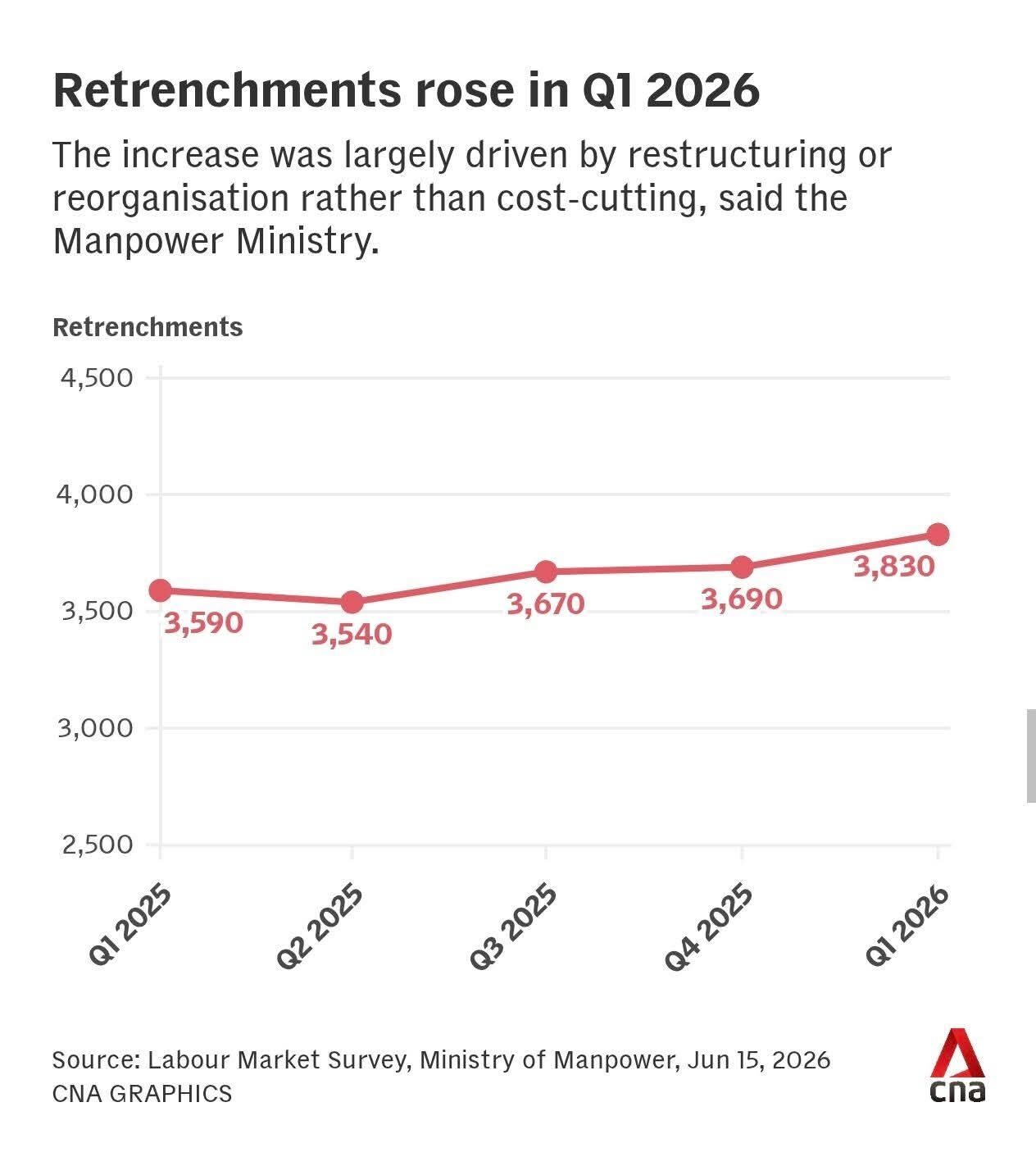
Retrenchments rose from 3,690 in the fourth quarter of 2025 to 3,830 in the first quarter of 2026 . However, the overall incidence remained low at 1.6 retrenched employees per 1,000 workers and stayed within the range associated with non-recessionary conditions.

The increase was concentrated mainly in manufacturing, financial services and professional services. The Ministry of Manpower said retrenchments continued to be driven largely by firm restructuring or reorganisation rather than a broad collapse in employment.

Channel NewsAsia chart showing Singapore retrenchments rising from 3,690 in Q4 2025 to 3,830 in Q1 2026
Singapore retrenchments increased slightly in the first quarter of 2026, but remained within non-recessionary norms. Chart published by Channel NewsAsia using Ministry of Manpower data.

The chart shows a labour market adjusting—not collapsing

The increase in retrenchments points more directly to companies changing how work is structured and which roles they need than to widespread job losses across the economy.

This distinction matters because restructuring can remove, consolidate or redesign positions even when the underlying business remains active and the broader labour market remains relatively healthy.

  • Teams and reporting lines are being consolidated.
  • Repetitive professional processes are being simplified.
  • AI-assisted tools are changing how knowledge work is performed.
  • Responsibilities are being redistributed across fewer roles.
  • Departments are being reorganised around new business priorities.

Why degree holders may appear more exposed in the data

The figures do not prove that qualifications cause retrenchment. A more plausible interpretation is that many degree holders are concentrated in professional roles and sectors where organisations are actively reorganising work.

1

Sector concentration

Degree holders are strongly represented in financial, professional, technical and managerial occupations—areas where restructuring was more visible during the quarter.

2

Organisational redesign

Knowledge-based work often sits inside departments that can be merged, streamlined or reorganised when companies change systems, priorities and operating models.

3

Changing task composition

A role may remain necessary while routine reporting, coordination or analysis is automated, consolidated or redistributed across fewer positions.

Sources and further reading

Ministry of Manpower — Labour Market Report, Q1 2026

Singapore's official report states that retrenchments rose slightly to 3,830, while the overall incidence remained low and within non-recessionary norms. It identifies restructuring and reorganisation as the main drivers.

View official report
Ministry of Manpower — Q1 2026 Press Release

MOM reported that the increase was concentrated in externally oriented sectors, including manufacturing, financial services and professional services, while overall labour-market outcomes remained resilient.

Read the release
Channel NewsAsia — Retrenchments and Degree Holders

CNA reported that retrenchment incidence among resident degree holders rose from 2.6 to 3.1 per 1,000 employees, the highest among the educational qualification groups reported.

Read the analysis
What the Data Really Means

The Degree Is Not Disappearing. The Role Around It Is Changing.

The evidence does not support the idea that university qualifications have suddenly become irrelevant. It points to a faster change in how professional work is divided, delivered and valued.

Many degree holders work in professional and knowledge-intensive roles where organisations are changing how responsibilities are distributed, how information is processed and how many people are required to complete a workflow.

Singapore's Ministry of Manpower found that AI was having a greater effect on job redesign and work processes than on broad-based job displacement. That distinction changes how professionals should interpret the risk.

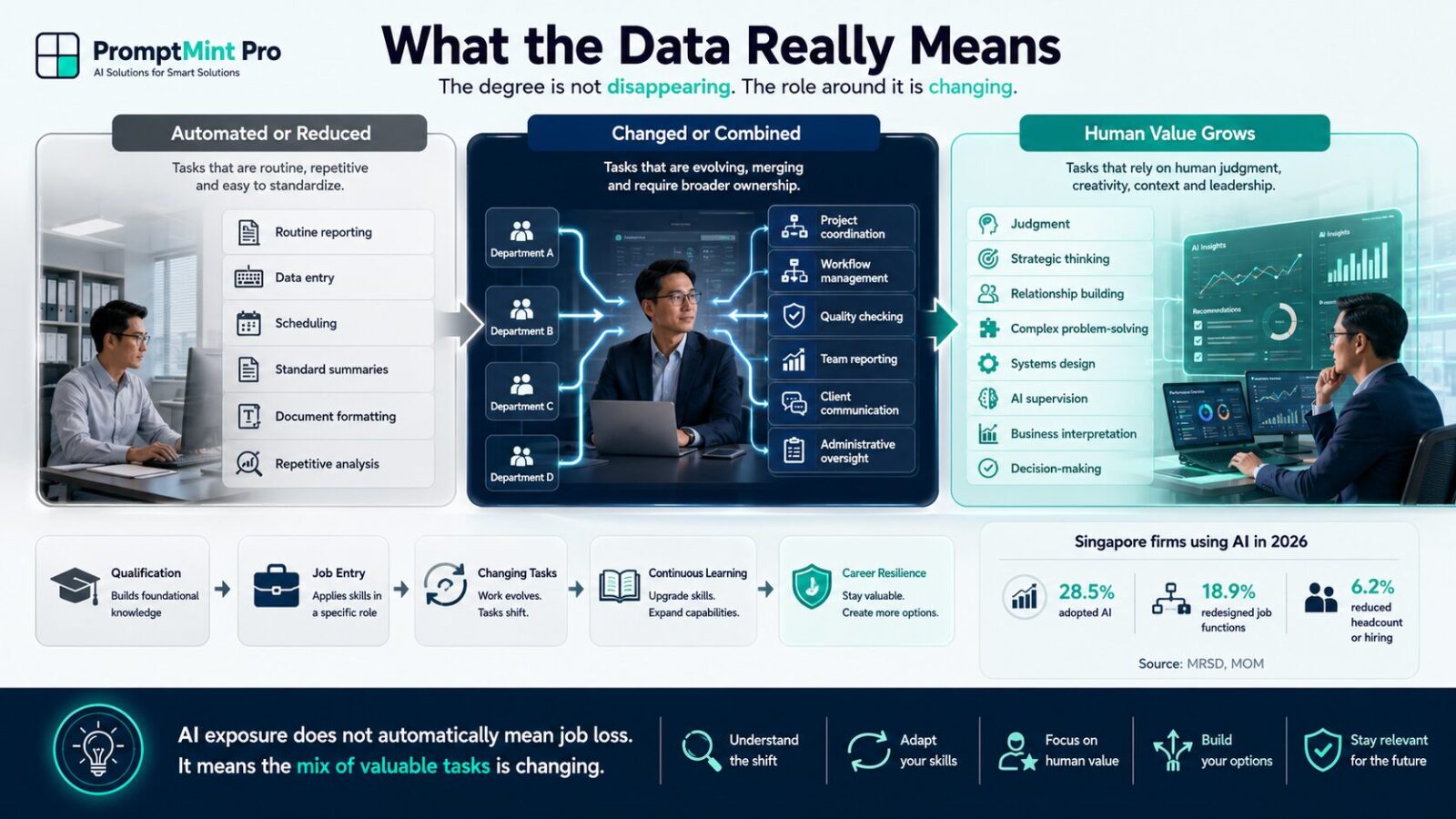
Professional role divided into automated, redesigned and increasingly valuable tasks in an AI-enabled workplace
AI is changing the mix of tasks inside professional roles, making adaptability, judgment and business value increasingly important.

The difference between job loss and job redesign

A job can remain necessary while the structure around it changes substantially. A company may still need financial analysis, project coordination, reporting or client service, but may not need the same number of people, approval layers or division of responsibilities.

  • A reporting team may shrink because dashboards generate routine updates.
  • A manager may supervise a wider scope because administrative work is automated.
  • Separate coordination roles may be merged into one technology-enabled position.
  • Junior analytical work may reduce while demand grows for interpretation and judgment.
  • A professional-services firm may retain specialists while removing duplicated management layers.

Three categories of professional work

The most useful way to think about AI exposure is to examine the changing mix of tasks inside a role rather than treating the job as one indivisible unit.

1 Automated or reduced

Tasks becoming easier to automate

Structured, repetitive and rules-based activities may require fewer hours or fewer people.

  • Routine reporting
  • Data entry
  • Standard summaries
  • Document formatting
  • Scheduling
  • Repetitive analysis
2 Changed or combined

Tasks being redesigned or consolidated

These activities remain important, but organisations may change how they are delivered and who owns them.

  • Project coordination
  • Workflow management
  • Quality checking
  • Administrative oversight
  • Team reporting
  • Process monitoring
3 Human value grows

Tasks becoming more valuable

These activities rely more heavily on context, accountability, judgment and human relationships.

  • Complex problem-solving
  • Strategic thinking
  • Decision-making
  • Relationship building
  • Systems design
  • AI supervision

Three conclusions the evidence supports

1

Education still matters

Formal qualifications continue to support entry into professional, technical and regulated occupations. The evidence does not justify claiming that degrees are useless.

2

Role stability is weaker

A qualification can retain value even while the role attached to it is restructured, consolidated or redesigned.

3

Complementary skills matter more

Professionals become more resilient when they combine domain knowledge with AI literacy, judgment, communication, systems thinking and measurable results.

Practical interpretation

A qualification is only one layer of professional value

A degree may show what someone studied. It does not automatically show whether they can use modern tools, improve workflows, interpret complex information or connect their work to meaningful outcomes.

  • Use current tools effectively.
  • Improve a workflow or operating process.
  • Interpret complex information accurately.
  • Make sound decisions under uncertainty.
  • Connect work to business or customer outcomes.
  • Adapt when responsibilities change.

Sources and further reading

Ministry of Manpower — Labour Market Report, Q1 2026

The official report found that AI was affecting job redesign and work processes more than broad employment levels, while restructuring remained the dominant reason for retrenchment.

View official report
OECD — Artificial Intelligence and Changing Skill Demand

OECD research finds continued demand for business, management, cognitive, emotional and digital capabilities in occupations with high AI exposure.

Read the research
World Economic Forum — Future of Jobs Report 2025

The report highlights significant expected changes in core job skills while emphasising the continued importance of both technology capabilities and human judgment.

Explore the skills outlook
Common Misconceptions

What the Retrenchment Data Does—and Does Not—Prove

Retrenchment statistics can generate strong reactions because they challenge assumptions about education, professional status and career security.

But a single headline rarely explains the full labour-market picture. The fact that degree holders recorded a higher retrenchment incidence does not mean every graduate is at greater risk, every professional occupation is disappearing or education has stopped providing value.

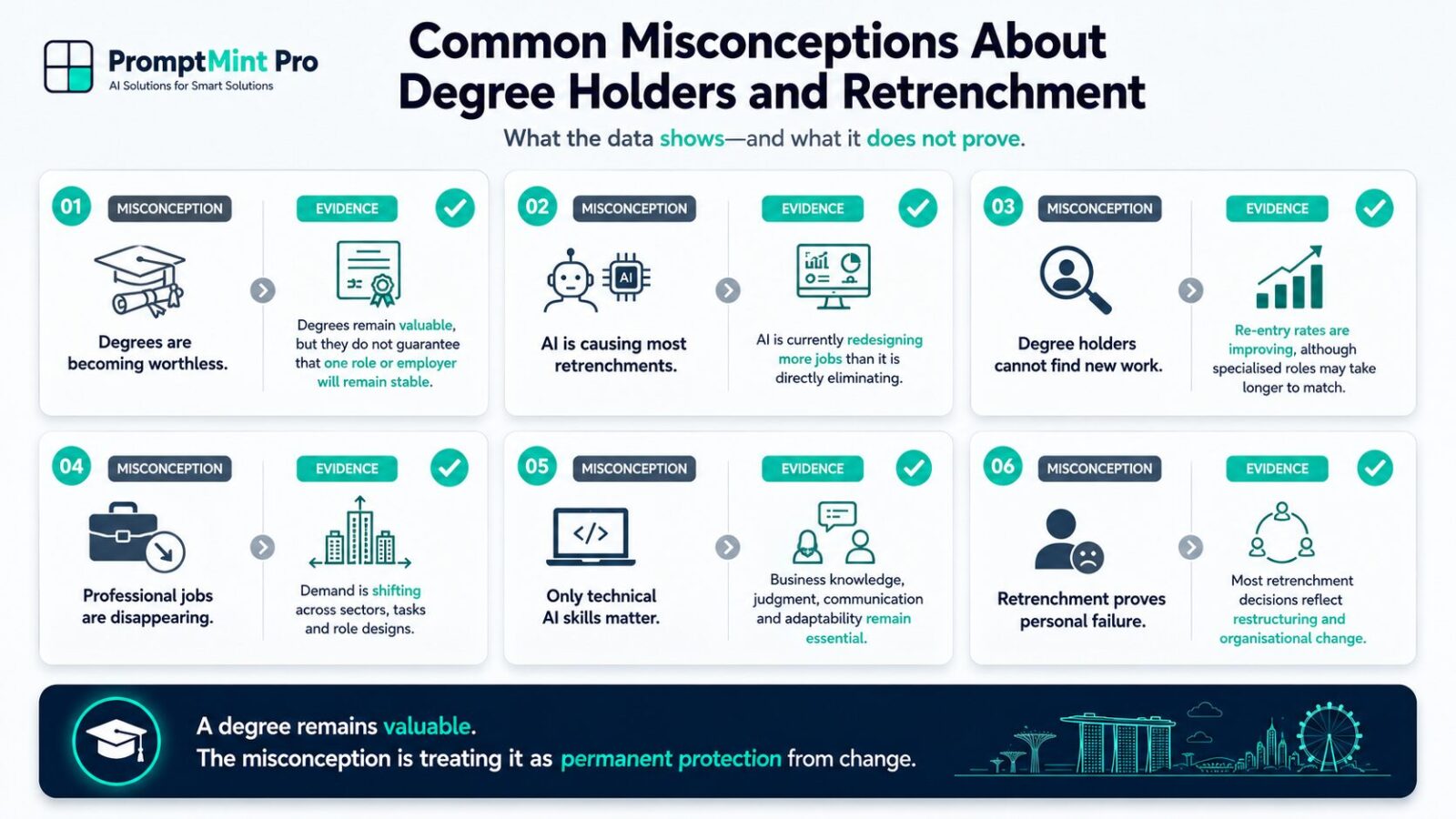
Six common misconceptions about degree holders, retrenchment, AI and career resilience compared with evidence-based conclusions
The retrenchment data does not show that degrees are worthless or that professional work is disappearing. It shows that qualifications must be supported by adaptability and current skills.

Six common conclusions the evidence does not support

Each misconception contains part of a real concern, but becomes misleading when it is treated as the full explanation.

1 Misconception

“University degrees are becoming worthless.”

What the evidence says

Degree holders continue to show strong overall employment outcomes. Formal education still supports entry into regulated, technical and professional occupations and remains a valuable foundation for many careers.

  • Access to regulated occupations
  • Foundational domain knowledge
  • Professional credibility
  • Stronger access to professional work
More accurate interpretation

A degree remains valuable, but its value should not be confused with permanent protection for one role or employer.

2 Misconception

“AI is directly causing most professional retrenchments.”

What the evidence says

Firms were more likely to report redesigning jobs and work processes than reducing employment because of AI. Restructuring decisions also reflect costs, demand, duplicated work and changing business models.

  • 28.5% of firms had adopted AI
  • 18.9% redesigned job functions
  • 6.2% reduced headcount or hiring
More accurate interpretation

AI is one driver of workplace change, but the current evidence points more strongly toward role redesign than mass displacement.

3 Misconception

“Degree holders cannot find new work.”

What the evidence says

Degree holders continue to re-enter employment, although specialised and senior professionals may take longer to find a role that matches their experience, salary expectations and domain expertise.

  • Six-month re-entry improved
  • Overall re-entry remained substantial
  • Specialised matching can take longer
More accurate interpretation

Degree holders may take longer to secure a comparable role, but the evidence does not show that they have become unemployable.

4 Misconception

“Professional jobs are disappearing.”

What the evidence says

Some professional functions are shrinking, others are being redesigned and new openings continue to appear across financial services, manufacturing, healthcare, education, auditing and technology support.

  • Some roles shrink
  • Some roles are redesigned
  • New roles and tasks emerge
More accurate interpretation

Demand may decline for one version of a professional role while increasing for another.

5 Misconception

“Only technical AI skills will keep professionals safe.”

What the evidence says

Most workers will not need to become AI engineers. They are more likely to need practical AI literacy combined with domain expertise, communication, management, judgment and problem-solving.

  • General digital competence
  • Business understanding
  • Communication and judgment
  • Adaptability and problem-solving
More accurate interpretation

Career resilience comes from combining useful AI literacy with strong domain knowledge and human judgment.

6 Misconception

“Retrenchment is evidence of personal failure.”

What the evidence says

Retrenchment is often connected to redundancy, restructuring, reorganisation or changing business needs rather than an individual professional's competence.

  • Departments are merged
  • Product lines change
  • Work moves across teams
  • Responsibilities are redistributed
More accurate interpretation

Retrenchment may show that a role no longer fits the organisation, not that the professional has lost their future value.

Misconception versus evidence-based conclusion

MisconceptionMore accurate conclusion
Degrees are worthless Degrees remain valuable but do not guarantee role stability.
AI is causing most retrenchments AI currently affects job redesign more than broad displacement.
Graduates cannot find work Many re-enter employment, although specialised matching may take longer.
Professional jobs are disappearing Demand is shifting across sectors, functions and task types.
Only technical AI skills matter Domain expertise, judgment, communication and adaptability remain essential.
Retrenchment means personal failure Most retrenchment decisions reflect organisational change.
Reader reflection

Which assumption are you relying on?

Career plans often depend on assumptions that feel reasonable today but may become unreliable as industries, tools and organisations change.

  • My qualification will always protect me.
  • My industry is too specialised to change.
  • My seniority makes my role secure.
  • AI cannot affect my work because I am not technical.
  • My employer will always need my current responsibilities.

Sources and further reading

Ministry of Manpower — Labour Market Report, Q1 2026

The official report provides data on retrenchment incidence, reasons for retrenchment, re-entry rates, vacancies and AI-related job redesign.

View official report
Ministry of Manpower — Labour Force in Singapore 2025

The report shows that degree holders remained highly employable overall, challenging the claim that formal qualifications have lost their labour-market value.

Read the findings
OECD — AI and the Changing Demand for Skills

OECD research explains that AI exposure often changes tasks and skill requirements rather than requiring every worker to become a specialised technical expert.

Read the research
Implications for Professionals

What Professionals Should Build Beyond Their Degree

A degree can provide knowledge, credibility and access to professional work. It cannot guarantee that one employer, job description or operating model will remain stable.

The strongest response is not panic. It is to deliberately build capabilities that remain useful when roles, tools and industries change.

The objective is to become less dependent on one employer, one narrow job function, one technical process, one source of income and one outdated way of working.

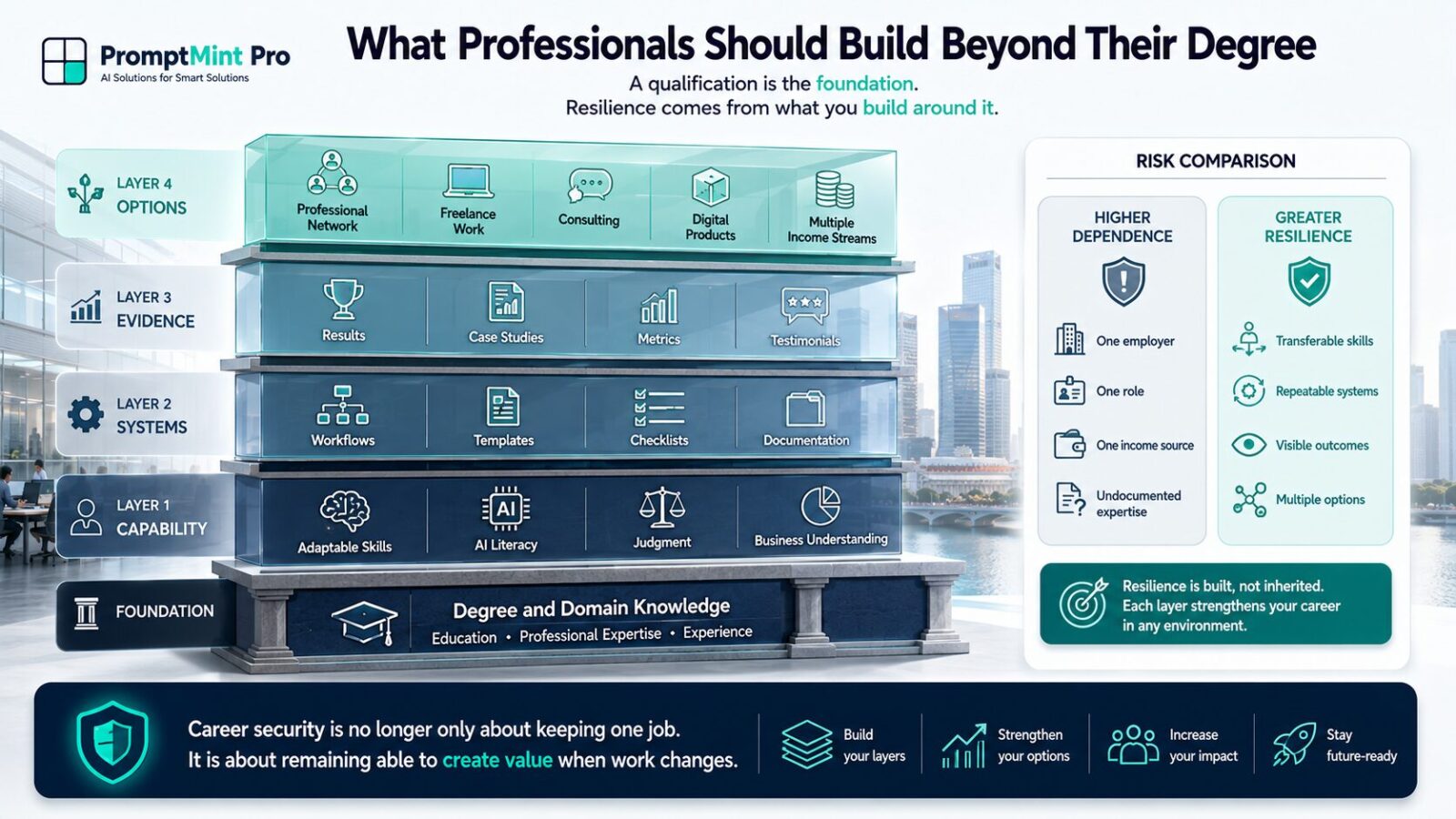
Career resilience framework showing adaptable skills, AI literacy, work systems, evidence of value and multiple income options
Modern career resilience is built by combining qualifications with adaptable skills, practical AI literacy, repeatable systems and multiple ways to create value.

Six things professionals should deliberately build

These capabilities strengthen employability, but more importantly, they reduce dependence on one role, one process and one employer.

1

Adaptable and transferable skills

Build capabilities that travel with you

Transferable skills remain useful across employers and industries because they are connected to how problems are solved rather than to one internal process.

  • Analytical thinking
  • Clear communication
  • Project management
  • Negotiation
  • Systems thinking
  • Commercial awareness
Practical action

Rewrite your experience as outcomes. Explain what improved, changed or became easier because of your work.

2

Practical AI literacy

Learn to work with AI without pretending to be an AI engineer

Most professionals need to understand where AI saves time, where human review remains essential and how to improve a workflow without automating a bad process.

  • Ask better questions
  • Verify AI-generated information
  • Protect confidential data
  • Review accuracy and risk
  • Combine AI with judgment
  • Measure the improvement
Practical action

Improve one recurring task with AI, then measure the time saved, quality gained or errors reduced.

3

Repeatable work systems

Make your expertise visible and reproducible

Professionals become more resilient when their value is not trapped inside memory, individual effort or undocumented knowledge.

  • Standard operating procedures
  • Decision checklists
  • Project templates
  • Reporting systems
  • Knowledge libraries
  • Quality-control workflows
Practical action

Document one repeated process: trigger, inputs, steps, decisions, checks and expected outcome.

4

Evidence of measurable value

Stop relying only on job titles

A title explains where you worked. Evidence explains what changed because you were there.

  • Revenue influenced
  • Costs reduced
  • Time saved
  • Risks avoided
  • Processes improved
  • Projects delivered
Practical action

Build a professional value inventory with the problem, contribution, result, evidence and transferable skills used.

5

Strong professional relationships

Career resilience is partly relational

Opportunities often emerge through former colleagues, clients, mentors, communities and collaborative projects rather than formal applications alone.

  • Former colleagues
  • Clients and partners
  • Professional communities
  • Industry associations
  • Mentors
  • Specialist networks
Practical action

Reconnect with five people you respect. Share something useful and ask what changes they are seeing in the market.

6

Multiple income options

Reduce dependence before disruption forces the decision

Building options does not require leaving employment immediately. It may begin with one small, tested way to create value independently.

  • Freelance projects
  • Consulting
  • Training or workshops
  • Templates
  • Digital products
  • Small recurring retainers
Practical action

Identify one skill people already ask you for help with and test it as a service, workshop, template or short consultation.

A four-layer framework for career resilience

A qualification is the foundation. Resilience grows from the layers built around it.

Layer 1

Capability

  • Domain expertise
  • Transferable skills
  • AI literacy
  • Judgment
Layer 2

Systems

  • Workflows
  • Templates
  • Checklists
  • Documentation
Layer 3

Evidence

  • Results
  • Case studies
  • Metrics
  • Testimonials
Layer 4

Options

  • Professional network
  • Freelance work
  • Consulting
  • Multiple income paths

Sources and further reading

Ministry of Manpower — Labour Market Report, Q1 2026

The official report shows that labour-market disruption was concentrated in selected sectors while the wider market remained resilient.

View official report
OECD — AI and the Changing Demand for Skills

OECD research concludes that AI-exposed workers need a combination of digital, business, cognitive and human capabilities rather than specialised engineering expertise alone.

Read the research
World Economic Forum — Future of Jobs Report 2025

The report highlights growing demand for technological literacy, analytical thinking, resilience, flexibility and lifelong learning.

Explore the skills outlook
IMDA — Building an AI-Fluent Singapore Workforce

Singapore's workforce initiatives emphasise practical AI fluency and broader adoption across professional roles and industries.

Read the announcement
Key Lessons

Key Lessons to Remember

The rise in retrenchments among degree holders is not evidence that education has lost its value. It is evidence that qualifications alone cannot guarantee long-term career security.

The professionals most likely to remain resilient are those who continue learning, adapt their skills, build repeatable systems and create more than one way to contribute value.

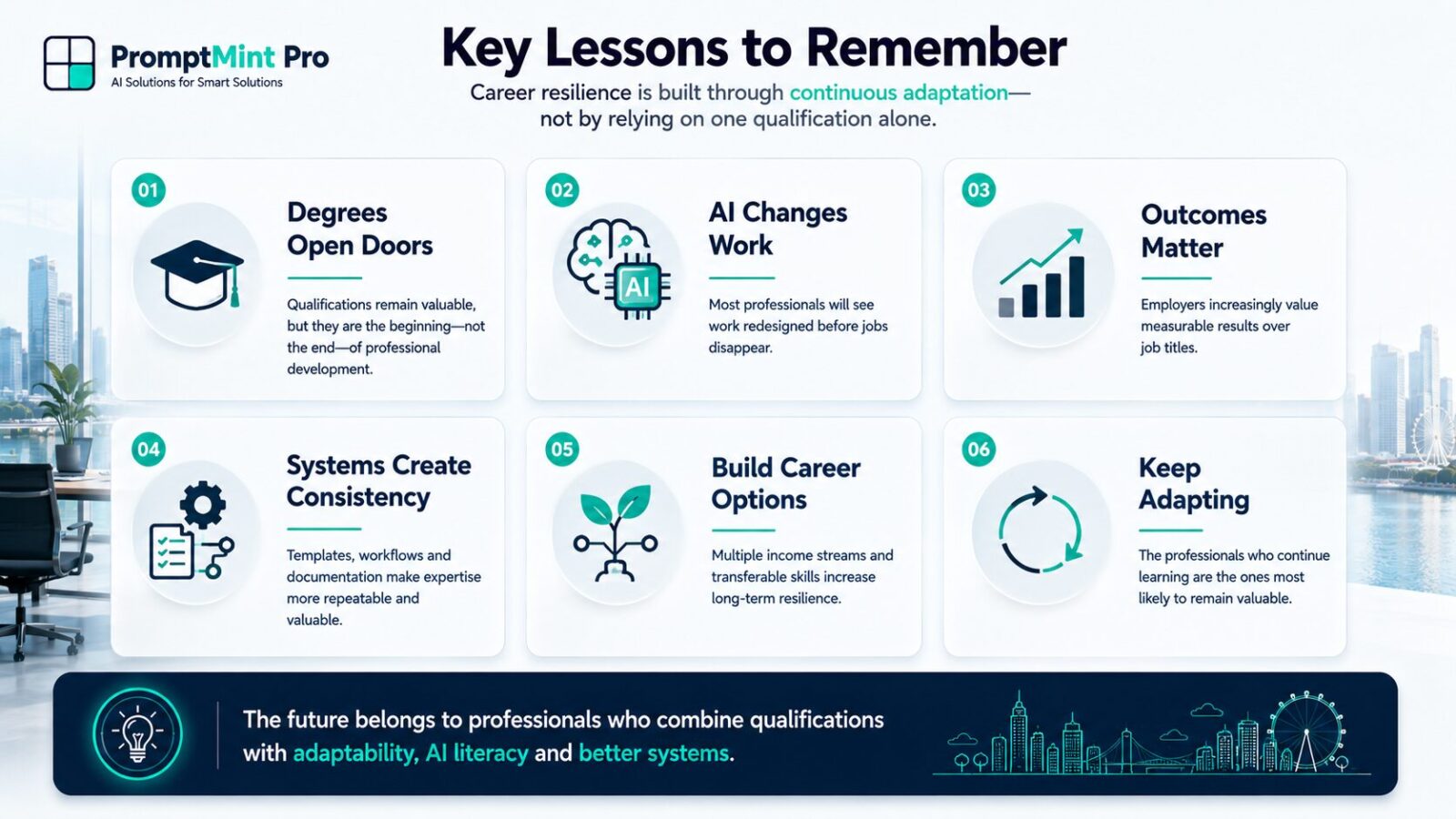
Six key lessons on career resilience after the rise in degree holder retrenchments
Qualifications remain valuable, but long-term career resilience increasingly depends on adaptability, practical AI literacy, repeatable systems and the ability to create value in different ways.

Six lessons for building a more resilient professional future

These are the ideas worth carrying forward after the headlines and quarterly figures are forgotten.

1 Degrees open doors

A degree does not keep every door open forever

A university qualification remains useful for developing knowledge, credibility and professional opportunities. However, industries, organisations and job responsibilities continue to change after graduation.


Treat education as the beginning of professional development, not the end of it.

2 AI changes work

AI is redesigning more work than it is directly eliminating

Many professionals are more likely to experience changed tasks, automated workflows and new expectations than immediate replacement of their entire occupation.


Practical AI literacy is becoming part of professional competence.

3 Outcomes matter

Professional value should be measured by results

Job titles and qualifications explain where someone worked and what they studied. Outcomes show the practical difference their work created.


Record problems solved, time saved, revenue influenced and systems improved.

4 Systems create consistency

Build systems, not only individual skills

Knowledge becomes easier to apply, improve and transfer when it is supported by templates, checklists, documented processes and AI-assisted workflows.


Systems turn personal effort into a reusable professional asset.

5 Build options

Career security increasingly comes from having options

Depending completely on one employer, one role or one source of income increases vulnerability when circumstances change.


Freelancing, consulting, teaching or digital products can begin as small experiments rather than immediate career changes.

6 Keep adapting

Adaptability is becoming a professional advantage

The strongest professionals are rarely those who expect one skill set or way of working to remain valuable forever. They continue learning and apply their experience to new problems.


Continuous learning is no longer optional maintenance. It is part of long-term career resilience.

Final reflection

Ask a better question about career security

The traditional question focuses on whether a qualification or employer can protect the current role. A more useful question focuses on how quickly professional value can move when circumstances change.

Old question

“Will my degree protect my career?”

Better question

“If my current role changed tomorrow, how quickly could I create value somewhere else?”

Sources and further reading

Ministry of Manpower — Labour Market Report, Q1 2026

The report supports the article's discussion of retrenchment, labour-market resilience and the role of restructuring in changing professional work.

View official report
OECD — AI and the Changing Demand for Skills

OECD research explains how AI changes tasks and skill demand while preserving the importance of business knowledge, judgment and human capabilities.

Read the research
World Economic Forum — Future of Jobs Report 2025

The report highlights the increasing importance of technological literacy, analytical thinking, resilience, flexibility and continuous learning.

Explore the skills outlook
Frequently Asked Questions

Frequently Asked Questions About Degree Holder Retrenchments

Recent labour-market reports have raised understandable questions about why degree holders are being retrenched and what professionals should do next.

The answers below separate what the evidence currently supports from the broader assumptions often attached to retrenchment, AI and the future of professional work.

1 Why are degree holders being retrenched?

A university degree remains valuable, but it cannot guarantee that a particular role, employer or operating model will remain unchanged.

Recent retrenchments have been influenced by organisational restructuring, changing business priorities, workflow redesign, technological adoption and economic conditions rather than qualifications alone.

Many affected employees worked in professional, managerial, executive and technical roles where companies reorganised teams, consolidated responsibilities or changed how work was delivered.

2 Are university degrees becoming less valuable?

No. Degrees continue to provide knowledge, professional credibility and access to many specialised, technical and regulated careers.

What is changing is the expectation that education alone will provide permanent career security. Employers increasingly expect professionals to combine formal education with adaptable skills, practical AI literacy, measurable outcomes and continuous learning.

A degree remains a strong foundation. It is no longer the complete career-resilience strategy.

3 Is AI causing professionals to lose their jobs?

AI is contributing to workplace change, but current evidence suggests that it is changing how many jobs are performed more often than eliminating entire professions.

Organisations are using AI to automate routine tasks, redesign workflows, consolidate responsibilities and change the skills expected inside existing positions.

Professionals who can use AI responsibly, verify its outputs and combine it with domain knowledge and human judgment are generally better positioned than those who ignore the change.

4 Which professionals are most affected by workplace disruption?

The effect varies by sector, employer and role. Positions containing a high proportion of repetitive, structured or easily standardised work may face greater redesign.

These activities may include:

  • Routine administrative processing
  • Standard reporting
  • Predictable information analysis
  • Document preparation
  • Scheduling and coordination
  • Repeated quality checks

Roles requiring accountability, complex judgment, leadership, relationship management and decisions under uncertainty remain more difficult to automate completely.

5 What skills are becoming more important in an AI economy?

Research consistently points toward a combination of technology, business and human capabilities rather than one narrow technical skill.

  • Analytical thinking
  • Clear communication
  • Problem-solving
  • Practical AI literacy
  • Systems thinking
  • Leadership and collaboration
  • Adaptability
  • Creative thinking
  • Continuous learning

These skills complement technical and domain expertise. They do not replace it.

6 Should professionals learn programming to stay employable?

Not necessarily. Most professionals do not need to become software developers, data scientists or machine-learning engineers.

It is often more useful to understand how AI can support everyday work, how to evaluate its outputs, where human review is required and how technology can improve a business process.

Programming may be valuable in some careers, but practical AI literacy, judgment and domain knowledge are more widely applicable.

7 Should I start a side business after being retrenched?

Not everyone needs to become an entrepreneur, and starting a business should not be treated as an automatic reaction to job loss.

However, freelancing, consulting, training, advisory work or digital products can reduce dependence on one employer and create additional options.

The appropriate path depends on your financial position, skills, risk tolerance, available time and the existence of a genuine customer problem you can solve.

8 How can I become more resilient if my job changes?

Start by building capabilities that remain useful beyond your current employer or job title.

  • Strengthen transferable skills
  • Develop practical AI literacy
  • Document repeatable workflows
  • Build evidence of measurable results
  • Maintain professional relationships
  • Explore more than one way to create value

Career resilience is less about predicting every disruption and more about remaining able to move when conditions change.

9 How can I assess my career resilience?

A useful assessment should examine your transferable skills, AI readiness, professional visibility, dependence on one employer, adaptability and ability to create value across different settings.

The PromptMint Career Resilience Diagnostic helps you identify your current strengths and the areas that may need more attention.

For professionals exploring consulting, freelancing or independent business ownership, the PromptMint Solopreneur Diagnostic helps identify the business-system bottleneck most likely to limit progress.

Sources and further reading

Ministry of Manpower — Labour Market Report, Q1 2026

Provides official data on retrenchment trends, restructuring, labour demand, unemployment and workforce re-entry in Singapore.

View official report
Ministry of Manpower — Labour Force in Singapore 2025

Shows employment outcomes across education levels and provides context for the continuing value of degree-level qualifications.

Read the findings
OECD — AI and the Changing Demand for Skills

Explains how AI changes tasks and required capabilities across occupations rather than simply eliminating complete job categories.

Read the research
World Economic Forum — Future of Jobs Report 2025

Identifies the technology and human skills employers expect to become increasingly important through 2030.

Explore the skills outlook
Scroll to Top