
Lead Generation System
Creates interest and opportunity
- Attracts attention
- Builds awareness
- Captures enquiries
- Starts conversations
Output: potential buyers
Lead Generation & Sales
If your sales process leaks opportunities, adding more leads simply creates more lost revenue. Fix the system before scaling your lead generation.
Identify sales bottlenecks before spending more time or money on traffic.
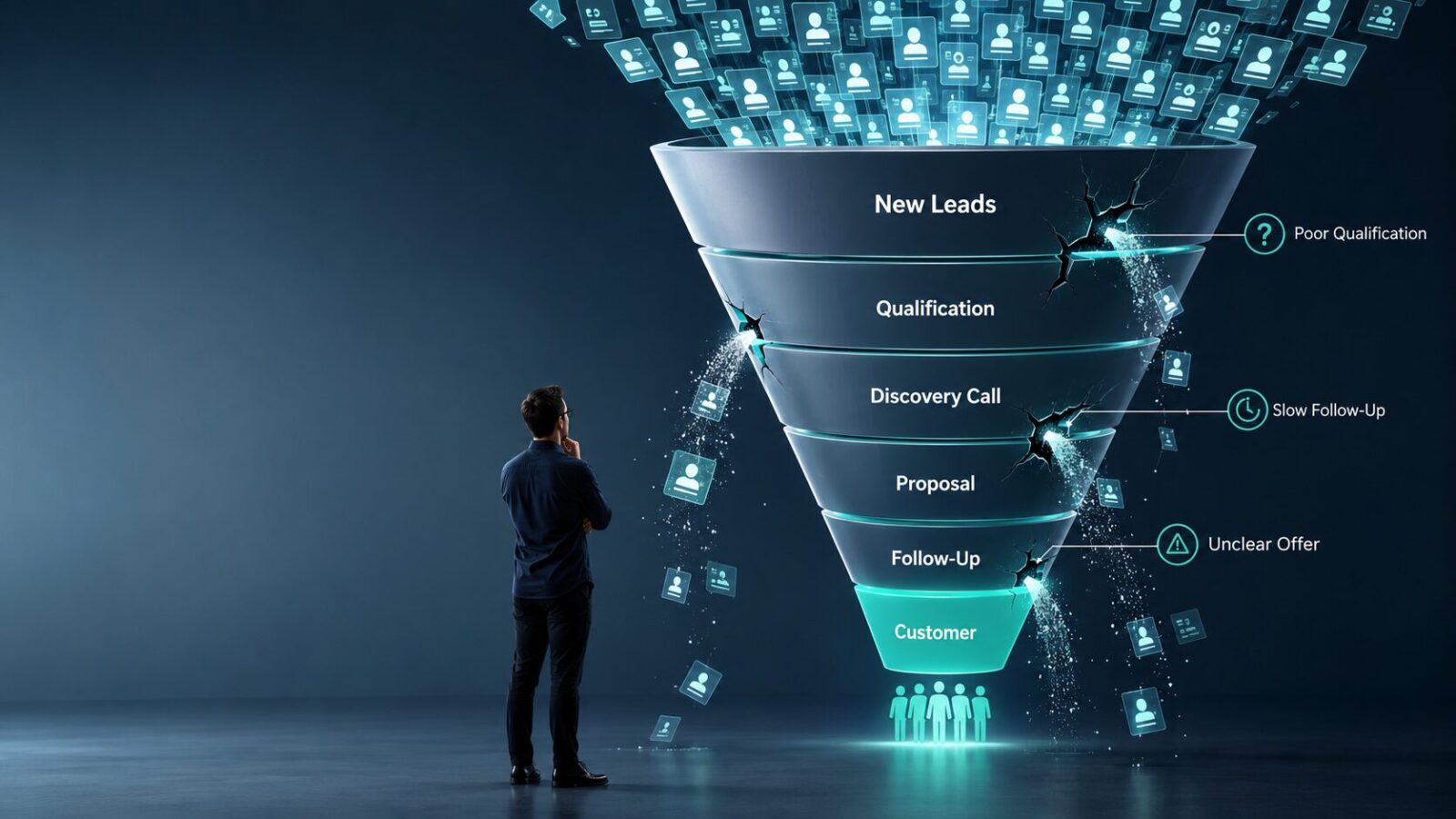
More leads will not fix a broken sales system if opportunities are leaking before they convert.
Sales System Diagnosis
A broken sales system is a sales process that attracts leads but fails to move them consistently toward becoming customers.
The problem is not always lead volume. Many solopreneurs already have enough interest coming in, but opportunities are lost through slow replies, weak qualification, unclear offers, inconsistent follow-up, or proposals that take too long to send.
Before improving your lead generation system, first check whether your current sales workflow can handle the leads you already have.
Simple test
If leads regularly disappear after showing interest, your sales process may be leaking opportunities before they become revenue.
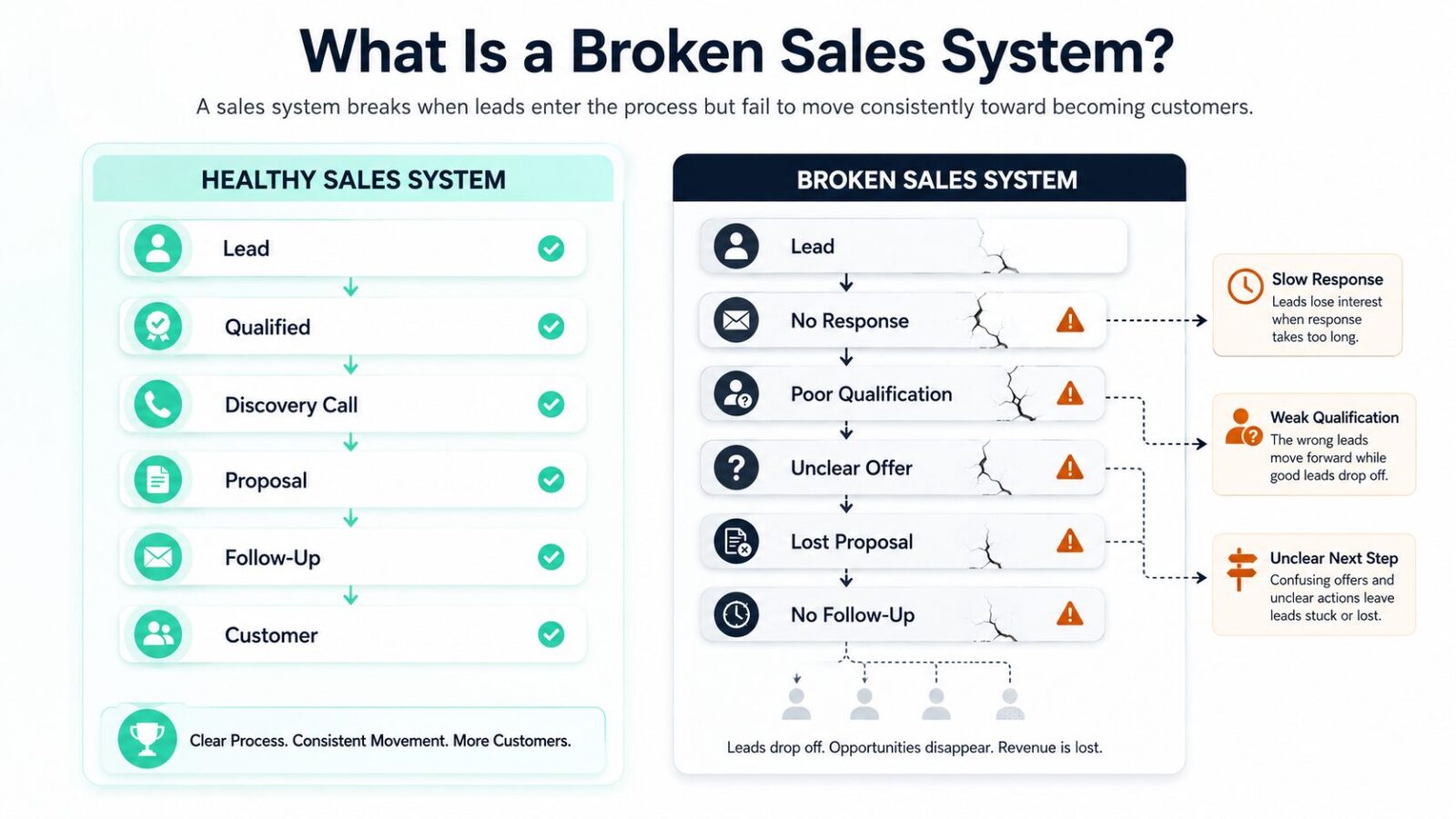
The system often looks functional from the outside
Enquiries may still arrive. Discovery calls may still happen. Proposals may still be sent. That makes the problem harder to notice because the process appears active even while qualified prospects quietly drop out.
A healthy sales system gives each prospect a clear next step. It also gives the business owner a consistent way to qualify leads, record decisions, send proposals, and follow up without relying on memory.
Lead Volume vs Sales Conversion
More leads will not fix a broken sales system. They only increase the pressure on a process that is already leaking opportunities.
A lead generation system can bring more enquiries into your business, but it cannot repair what happens after someone shows interest. If leads are not qualified, followed up with, or guided toward a clear next step, extra volume simply creates more lost chances.
The better first move is to improve sales conversion inside the pipeline you already have. When existing leads move more reliably from enquiry to customer, every future marketing effort becomes more valuable.
Practical insight
Before asking how to attract more traffic, identify where your current leads stop moving forward.
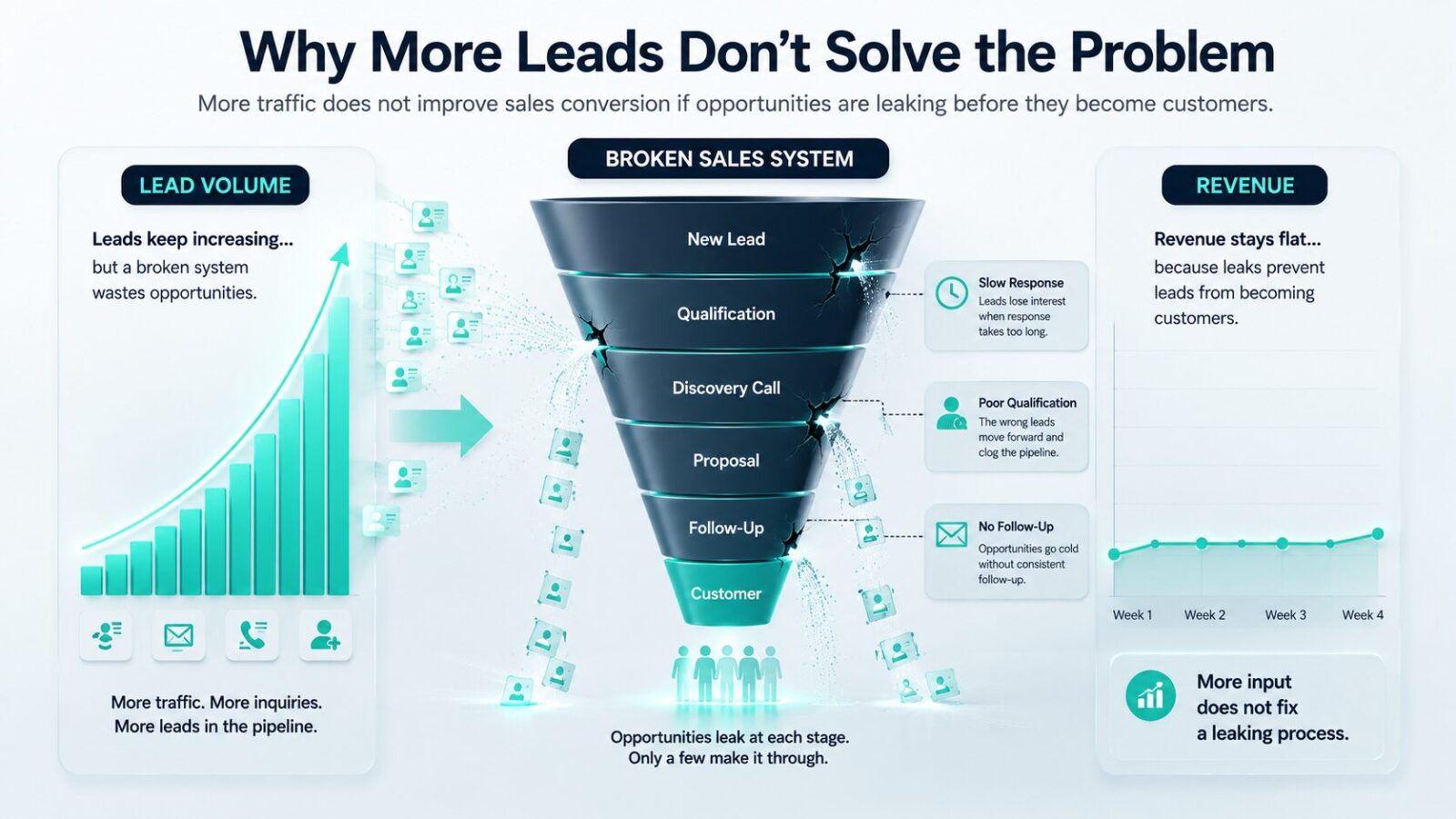
When sales are slow, generating more leads feels like the obvious response. It creates activity, fills the inbox, and gives the impression that the business is moving forward.
But activity is not the same as progress. If prospects are waiting days for a response, leaving discovery calls without a clear next step, or receiving proposals that are never followed up, increasing lead volume only feeds the same weak process.
Simple example
Doubling the leads does not always double the sales
The lead volume doubled, but the underlying conversion rate stayed at 3%. The business created more work without improving the system.
Marketing vs Sales
A lead generation system creates opportunities. A sales system helps the right people become customers.
Marketing gets attention and brings people into your business through content, referrals, SEO, advertising, and social media. Its job is to create awareness and interest among people who may need what you offer.
Sales begins after someone shows interest. It helps the prospect understand the offer, decide whether it fits their needs, and move toward a clear next step.
The handoff matters
Marketing creates the opportunity. Sales turns that opportunity into a decision.
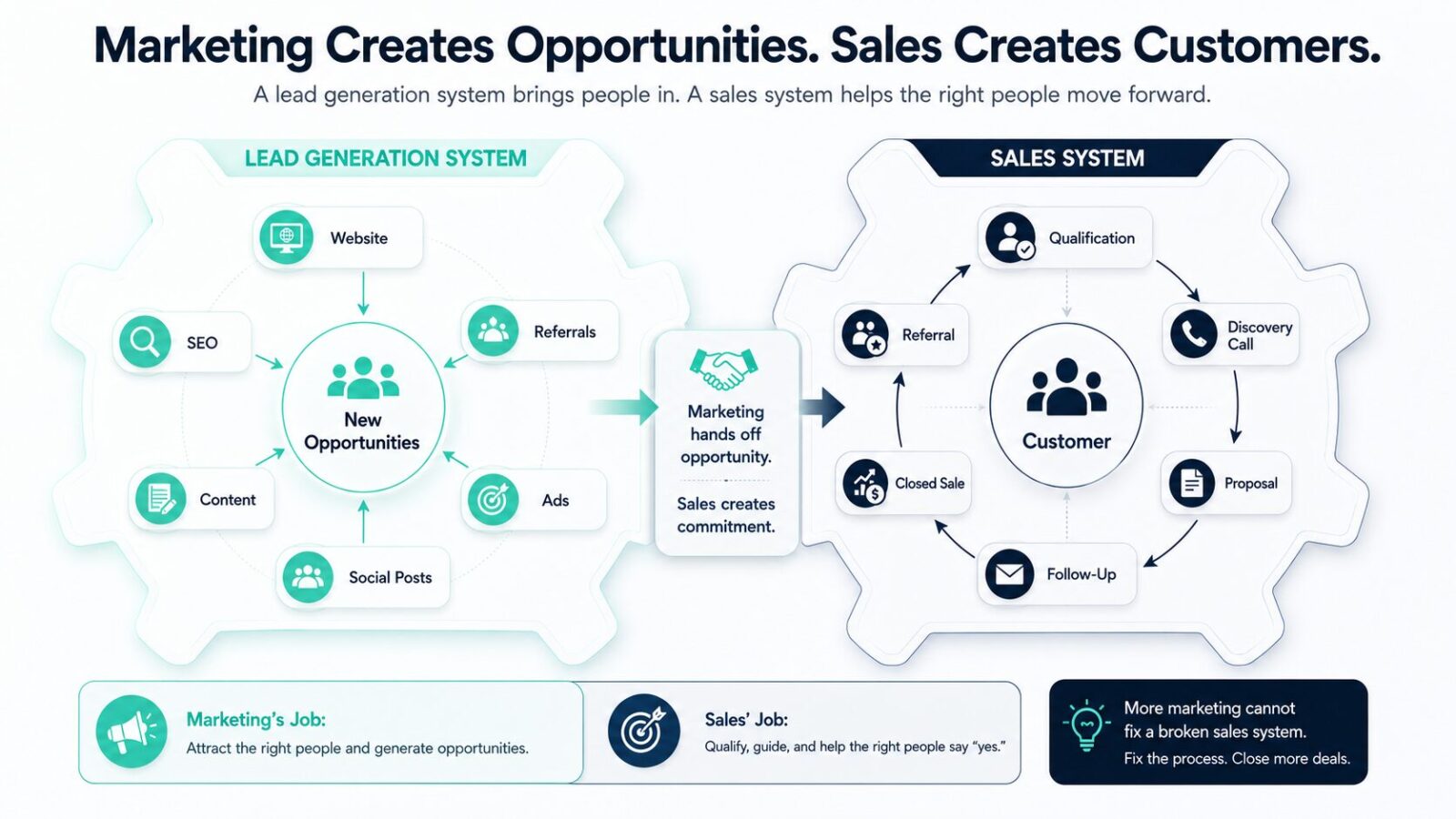
A business may be visible, receive regular enquiries, and still struggle to generate reliable revenue. This often happens when the lead generation system is working, but the sales process is not.
Weak qualification allows poor-fit prospects into the pipeline. Unstructured discovery calls fail to uncover the real problem. Proposals arrive without clear next steps. Follow-up depends on memory and disappears when the business owner gets busy.
In that situation, increasing marketing activity creates more conversations, but not necessarily more customers. It may even create more administrative work and make the underlying problem harder to see.
Lead Generation System
Output: potential buyers
Sales System
Output: customers
Practical example
Imagine a consultant receives 30 enquiries from SEO and referrals during the month. That suggests the lead generation system is creating demand. But if only five prospects receive a timely reply and just one proposal is followed up, the real constraint is not marketing.
The better move is to improve response time, qualification, proposal delivery, and follow-up before trying to generate another 30 enquiries.
Sales Pipeline Diagnosis
The biggest drop between two sales stages usually reveals the bottleneck you should fix first.
A broken sales system is rarely broken everywhere. More often, one weak stage causes prospects to stall, disappear, or lose confidence before they become customers.
Instead of looking only at total lead volume, measure how many prospects move from one stage to the next. This shows whether the real problem is qualification, discovery calls, proposals, follow-up, or closing.
What to look for
Find the stage with the largest percentage drop, not simply the stage with the smallest number.
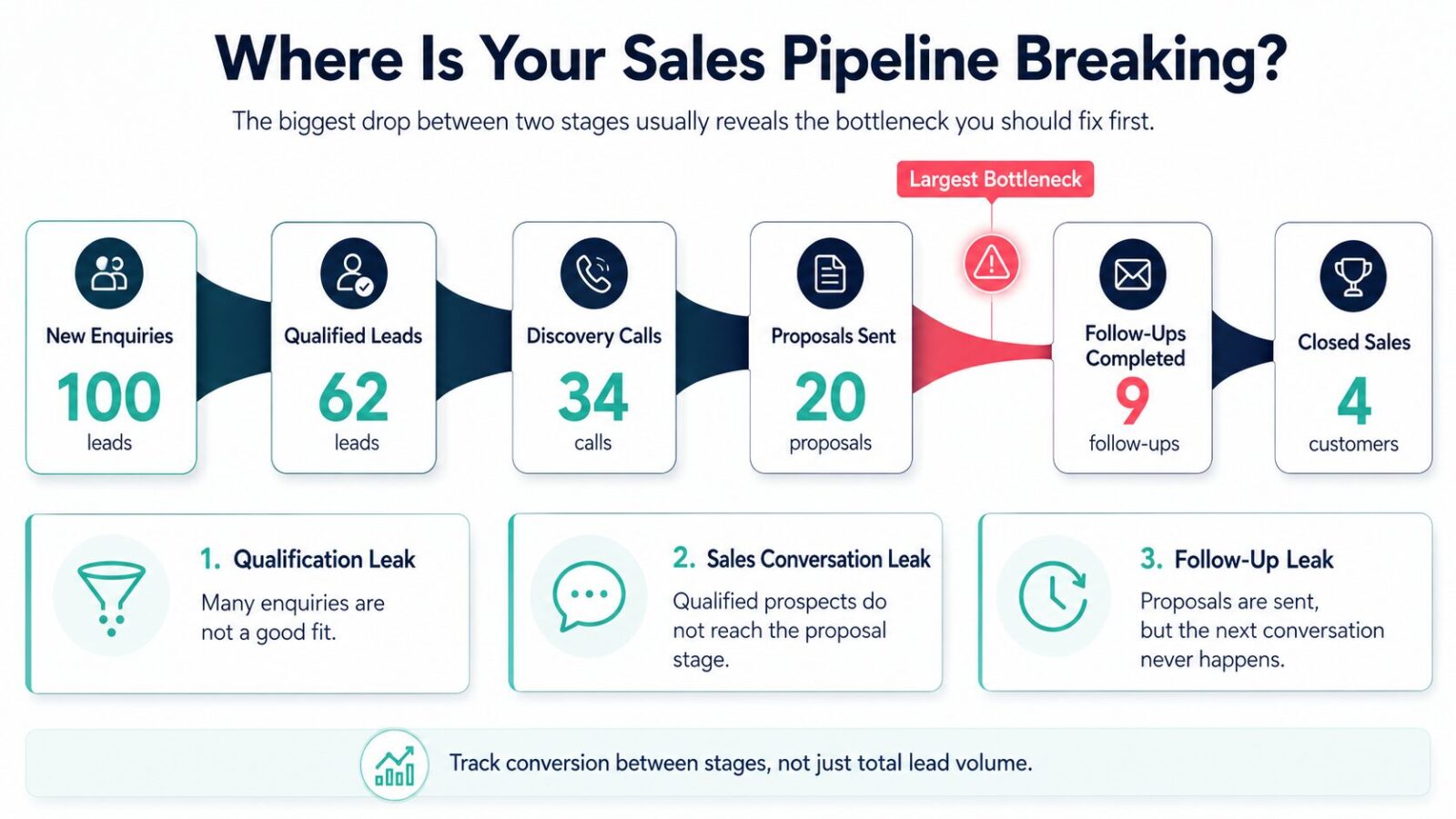
Imagine that 100 people enquire, 62 are qualified, 34 book a discovery call, 20 receive a proposal, nine receive a proper follow-up, and four become customers.
Looking only at the final result may lead you to conclude that the business needs more enquiries. But the largest operational weakness may actually sit between proposals and follow-up, where more than half of the opportunities stop receiving active attention.
That matters because the solution is different. A lead generation problem may require better content, referrals, SEO, or outreach. A follow-up problem may require a simple reminder system, clearer ownership, and a standard follow-up sequence.
Qualification Rate
62 of 100 enquiries were qualified.
Proposal Rate
20 of 34 discovery calls became proposals.
Follow-Up Rate
Only nine of 20 proposals received follow-up.
Diagnose the stage, then choose the solution
A large drop here may mean your marketing attracts the wrong audience or your offer is not clearly positioned.
A large drop here may point to weak qualification, unclear value, or sales conversations that do not uncover the real need.
A large drop here often means follow-up depends on memory, timing is inconsistent, or the prospect lacks a clear next step.
Practical Action
Create a simple spreadsheet or CRM view with one column for each sales stage. Record how many prospects enter and leave every stage, then calculate the percentage that moves forward.
Do not try to fix every weakness at once. Start with the largest meaningful drop, improve that stage, and measure whether the conversion rate changes.
Sales System Warning Signs
A broken sales system often reveals itself through repeated patterns long before the underlying problem becomes obvious.
You may still receive enquiries, hold discovery calls, and send proposals. But if prospects repeatedly disappear, follow-up is inconsistent, or you cannot explain where sales are being lost, the process is not working reliably.
One isolated mistake does not mean your entire sales process is broken. Several recurring warning signs, however, usually point to a system problem rather than a temporary slowdown.
Quick Diagnosis
Count how many of the five warning signs below happen regularly. The more signs you recognize, the more likely your sales process needs redesigning.
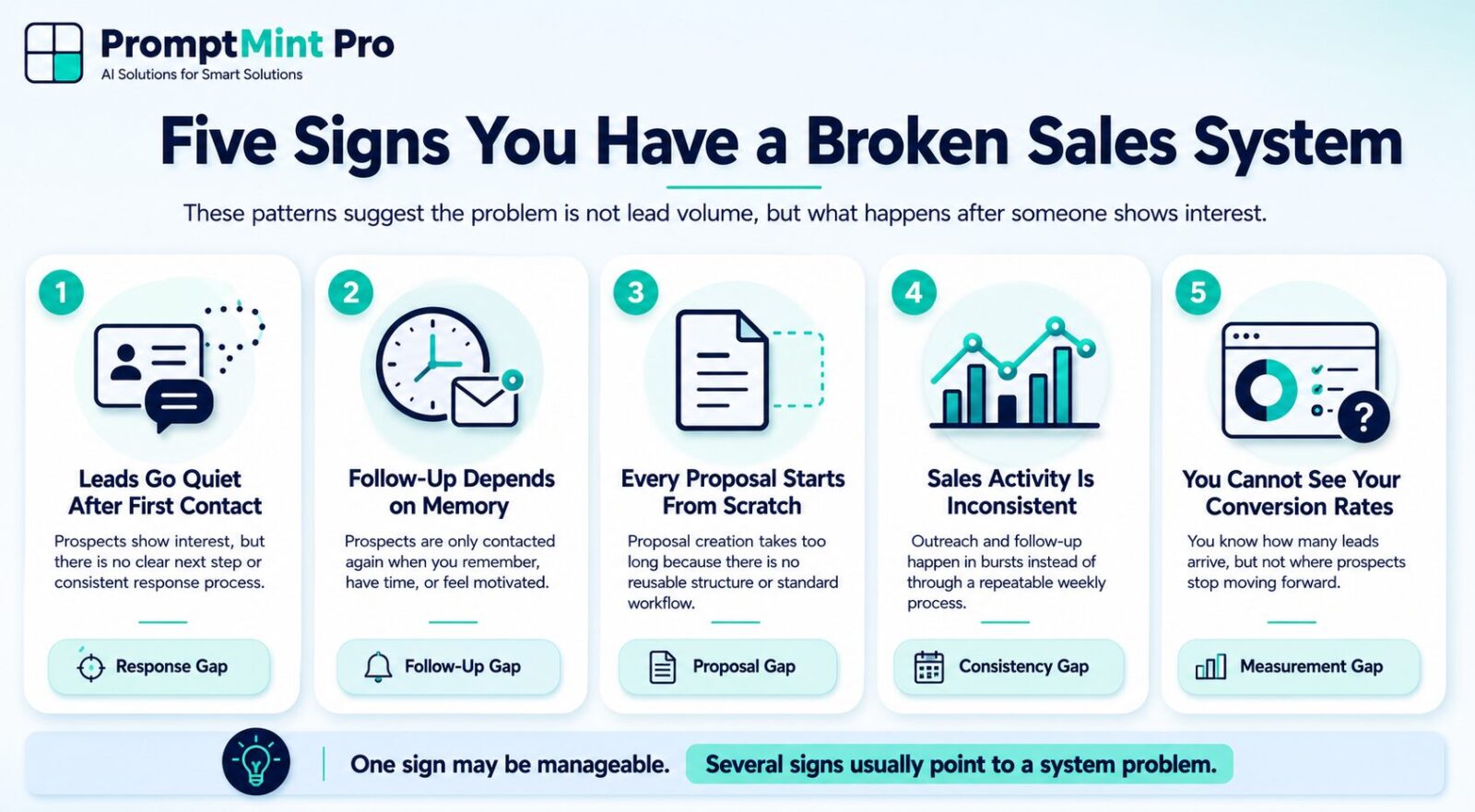
Every business occasionally loses a lead or forgets a follow-up. The concern begins when the same failure happens repeatedly and there is no reliable process to prevent it.
These five signs show where a sales workflow commonly breaks down for solopreneurs.
Someone fills in a form, sends a message, or asks for more information. You reply, but the conversation ends without a clear next step.
Prospects are contacted again only when you remember, notice an old email, or have enough time to review previous conversations.
You rewrite the same service explanation, pricing structure, project scope, and next steps each time a prospect requests a proposal.
You focus intensely on outreach when work is slow, then stop selling when client delivery becomes busy.
You may know how many enquiries arrive or how much revenue you earned, but you cannot see how many prospects moved through qualification, discovery, proposal, follow-up, and closing.
Self-Assessment
Your sales process may need a small improvement rather than a full redesign.
Several stages are likely relying too heavily on memory or manual effort.
Your sales workflow probably needs to be mapped, standardized, and measured.
Your Next Step
Every business loses some opportunities. The goal is not to eliminate every leak, but to identify the stage that is limiting your results the most.
Review your recent enquiries. Where do prospects most often stop moving forward? Is it after the first reply, after discovery calls, after proposals, or during follow-up?
Improving one weak stage often produces better results than trying to rebuild the entire process at once.
Free Business Diagnostic
The PromptMint Solopreneur Diagnostic helps you identify the business system holding back your progress, including lead generation, sales, execution, operations, and AI readiness.
Start the Free Solopreneur DiagnosticConversion Before Traffic
You can improve sales conversion by strengthening what happens between the first enquiry and the final buying decision.
When sales are slow, generating more traffic can feel like the fastest solution. But if your existing process loses prospects through slow replies, poor qualification, unclear proposals, or inconsistent follow-up, more traffic only creates more unfinished conversations.
A better approach is to improve the percentage of existing leads that move forward. Even a small increase at several stages can produce more customers without increasing your marketing budget.
Conversion Principle
The goal is not to pressure more people into buying. It is to remove unnecessary friction so qualified prospects can make a clear decision.
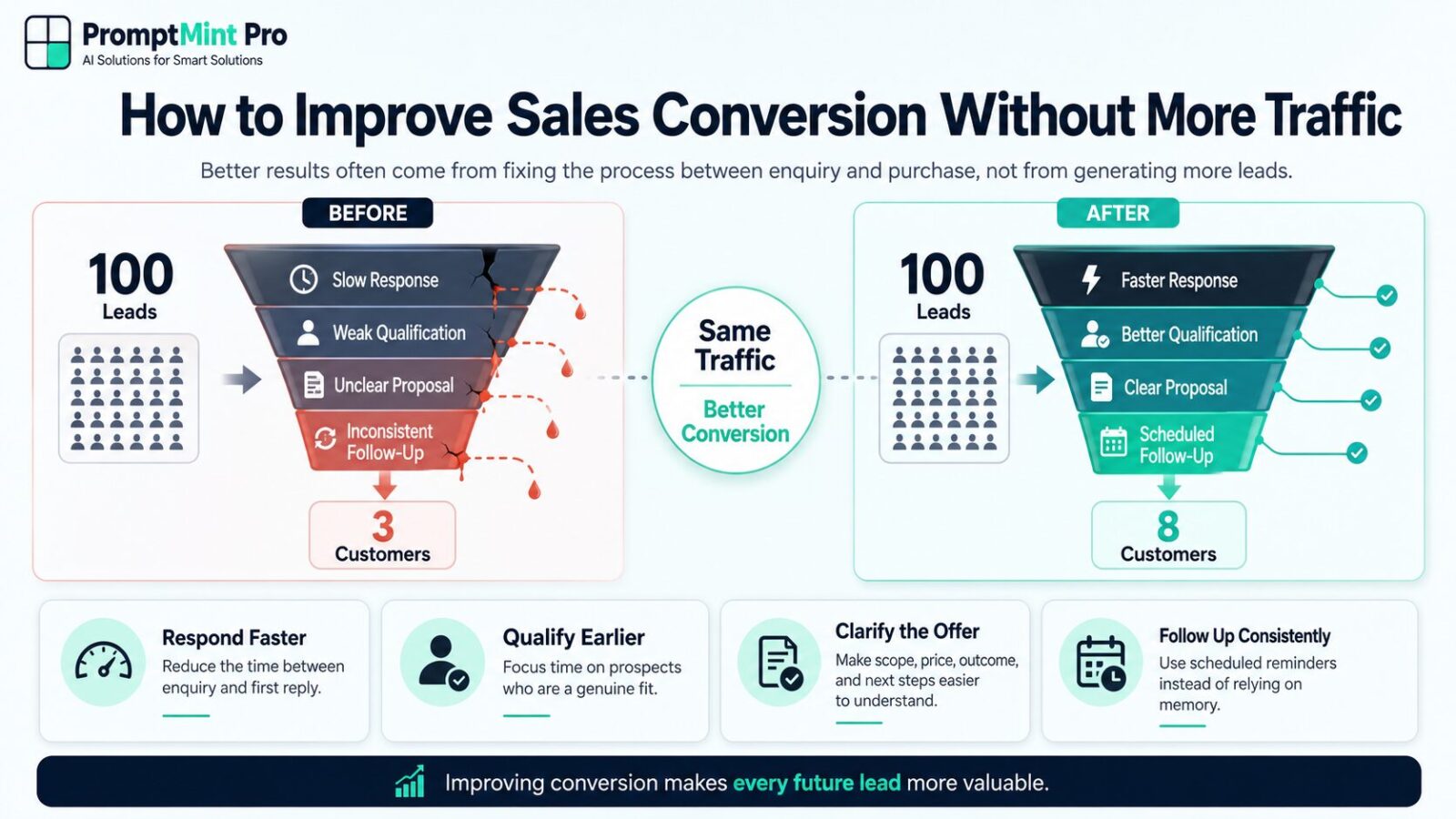
Imagine two businesses each receive 100 enquiries. The first business responds slowly, qualifies inconsistently, sends confusing proposals, and follows up only when there is time. It closes three customers.
The second business receives the same 100 enquiries. It replies quickly, filters poor-fit prospects early, presents a clear offer, and schedules every follow-up. It closes eight customers.
The difference is not traffic. It is the quality and consistency of the sales process.
Before
Customers from 100 leads
Conversion rate: 3%
After
Customers from 100 leads
Conversion rate: 8%
Four Practical Improvements
You do not need to rebuild your entire sales system at once. Start with the stages that repeatedly delay or lose qualified prospects.
Reduce the delay between the enquiry and your first meaningful response.
Identify whether the prospect has the right problem, budget, timing, and decision-making authority.
Make the outcome, scope, price, timeline, and next step easy to understand.
Continue the conversation at planned intervals instead of waiting for the prospect to return.
What to Measure
How many new enquiries receive a meaningful reply?
How many enquiries are a genuine fit for your offer?
How many qualified conversations result in a proposal?
How many proposals become paying customers?
Practical Action
Review your ten most recent sales opportunities. Identify the stage where the highest number of qualified prospects stopped moving forward.
Then make one operational improvement. That may mean writing a faster response template, creating qualification questions, standardizing your proposal, or scheduling follow-up reminders.
Measure the result for several weeks before changing another stage. This makes it easier to see which improvement actually increased conversion.
Diagnose Before You Fix
The right solution depends on where qualified prospects stop moving forward.
When sales are slow, it is easy to assume that the business needs more leads. But low revenue can come from several different problems, including weak visibility, poor qualification, ineffective discovery calls, unclear proposals, inconsistent follow-up, or a difficult buying decision.
Each problem requires a different response. Increasing marketing will not repair a broken sales system, just as improving follow-up will not help if the business receives too few relevant enquiries.
Diagnostic Principle
Fix the earliest meaningful stage where suitable prospects stop progressing. Improvements later in the pipeline will have limited value if the earlier stage remains weak.
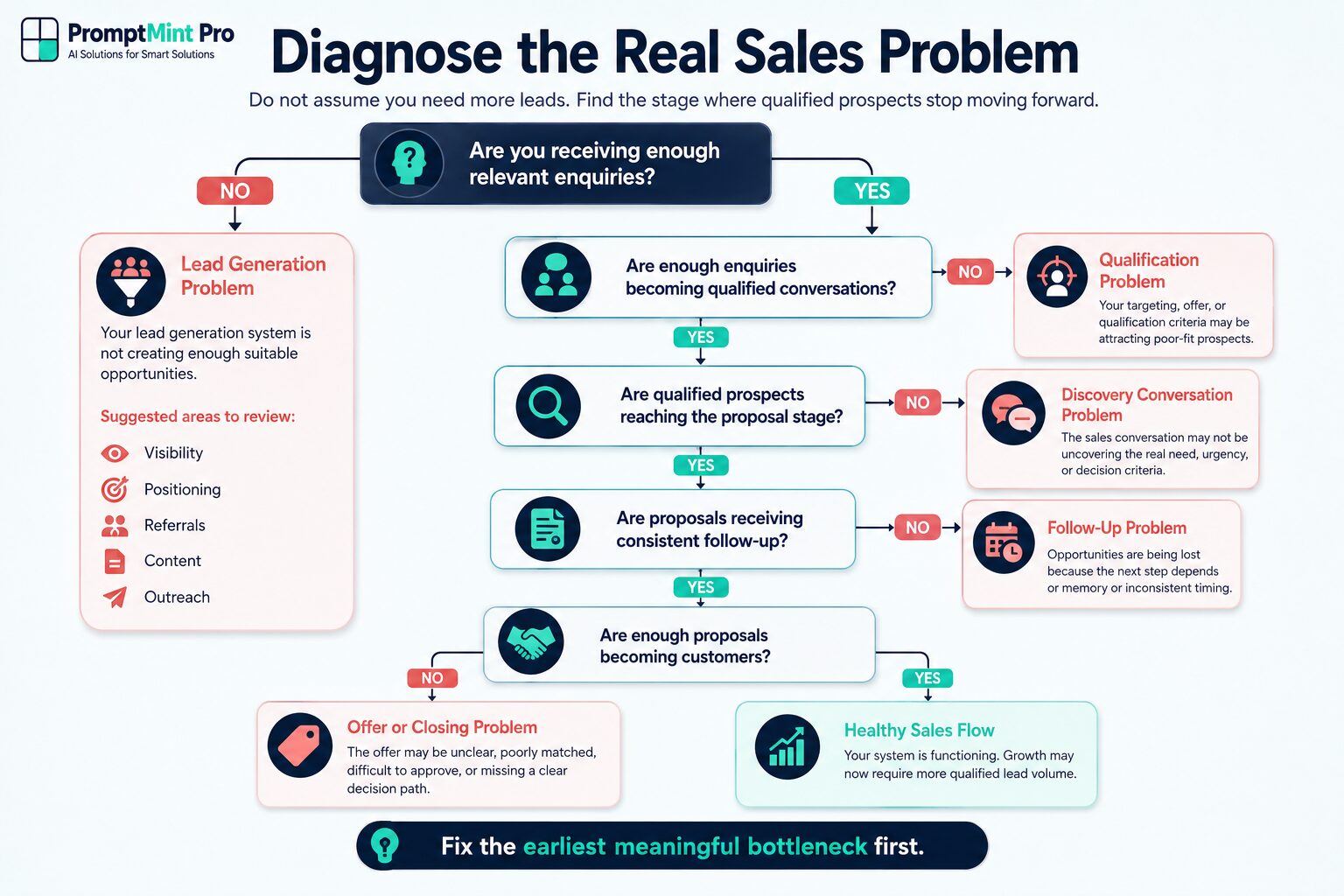
A useful diagnosis follows the sales journey in order. Begin with relevant enquiries, then review qualification, discovery, proposals, follow-up, and closing.
Once you find a meaningful drop, pause. That stage is the most likely constraint. Fixing it before moving further down the pipeline prevents you from solving the wrong problem.
Count enquiries from people who reasonably match your target customer, not every visitor, follower, or casual question.
Review visibility, positioning, referrals, content, SEO, and outreach.
Continue to qualification.
A qualified prospect has the right problem, enough urgency, a realistic budget, and a reasonable path to making a decision.
Review your audience, offer, messaging, and qualification criteria.
Continue to discovery.
Discovery should clarify the prospect's problem, desired outcome, urgency, decision process, and whether your offer is suitable.
Improve the questions, structure, and next steps in your sales conversation.
Continue to proposals and follow-up.
A proposal is not the end of the sales process. Prospects may need clarification, internal approval, reassurance, or a reminder before deciding.
Create scheduled reminders, reusable messages, and a defined follow-up sequence.
Continue to the buying decision.
If qualified prospects receive clear proposals and consistent follow-up but still do not buy, review the offer and decision process.
Review pricing, value, risk, scope, timing, proof, and how clearly the next step is presented.
Your system may be ready for more qualified lead volume.
Match the Problem to the Fix
Few relevant enquiries
Likely problemVisibility, positioning, audience targeting, or lead generation.
Possible responseImprove content, referrals, outreach, search visibility, or offer messaging.
Many enquiries, few qualified calls
Likely problemPoor-fit traffic, unclear offer positioning, or weak qualification.
Possible responseClarify who the offer is for and add qualification questions before calls.
Many proposals, few decisions
Likely problemFollow-up, offer clarity, pricing, risk, or a difficult approval process.
Possible responseImprove the proposal, schedule follow-up, address objections, and simplify the decision.
Practical Example
A consultant receives 25 relevant enquiries each month, holds 12 discovery calls, and sends eight proposals. Only two proposals receive a follow-up, and one becomes a customer.
The consultant may believe the business needs 50 enquiries to grow. But the lead generation system is already producing opportunities. The clearest bottleneck is that six of the eight proposals are not actively followed up.
In this case, a simple follow-up system is likely to improve sales conversion faster and at a lower cost than doubling website traffic.
Practical Action
Review your 20 most recent enquiries and record how many reached each stage: qualified, discovery call, proposal, follow-up, and customer.
Calculate the conversion rate between each stage. The earliest large drop among otherwise suitable prospects is the strongest place to begin.
Choose one improvement, test it for several weeks, and measure whether more prospects move forward before changing another part of the system.
AI-Assisted Sales Systems
AI can improve a good sales system, but it cannot replace the structure, judgment, and consistency that make the system work.
When a sales process is unclear, adding AI usually creates faster confusion. It may help draft emails, summarize calls, or update records, but those tasks will not solve weak qualification, an unclear offer, or a missing follow-up process.
AI becomes more useful after the workflow is defined. Once you know how leads should be qualified, what happens during discovery, how proposals are structured, and when follow-up occurs, AI can reduce manual effort and improve consistency.
Core Principle
Automation amplifies the process already in place. A strong system becomes easier to run. A broken sales system often becomes faster at producing the same weak result.
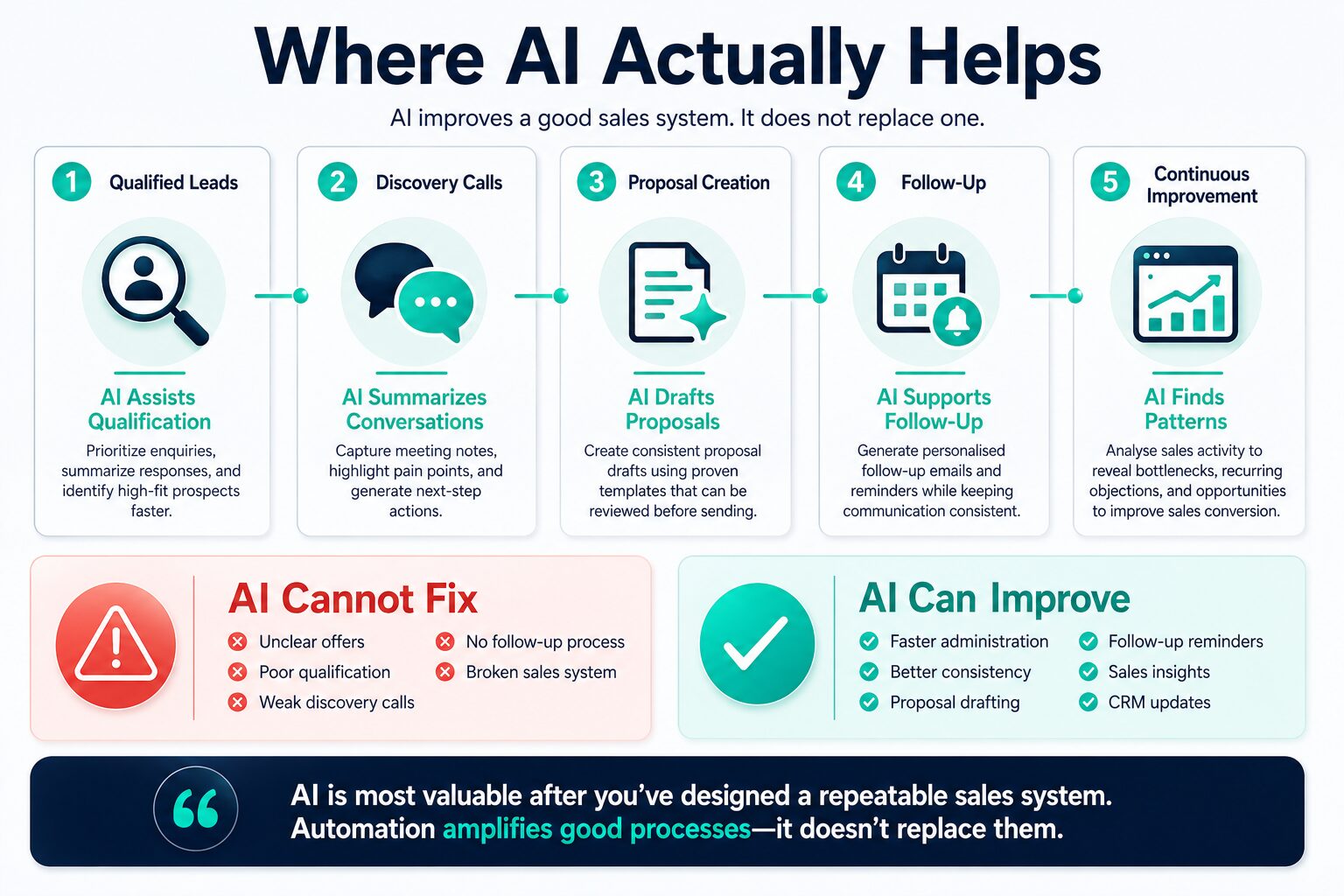
The most useful sales tasks for AI are usually repetitive, administrative, or pattern-based. These are tasks where speed and consistency matter, but a human still needs to review the result and make the final decision.
Qualification, trust, negotiation, and closing still depend on context. AI can help organize information, but it cannot fully understand the prospect's priorities, internal politics, confidence level, or readiness to buy.
AI can extract useful details from forms, emails, and notes, then organize prospects according to your qualification criteria.
AI can summarize discovery calls, identify recurring pain points, and produce a structured list of decisions and next actions.
AI can create a first proposal draft using your standard format, service options, scope, pricing rules, and discovery notes.
AI can draft personalized follow-up messages based on the previous conversation, proposal, and agreed next step.
AI can review sales notes, lost deals, objections, response times, and conversion data to surface repeated issues that may be difficult to notice manually.
What AI Can and Cannot Do
AI Cannot Fix
AI Can Improve
Practical Example
A consultant may decide that every proposal receives three follow-ups: two days after sending, seven days later, and one final check-in after fourteen days.
Once that sequence is defined, AI can draft each message using the prospect's situation, the previous conversation, and the proposal details. The consultant still reviews the message and decides whether it should be sent.
Without the sequence, AI has no reliable timing, objective, or context. It may produce a polished email, but it cannot decide how the sales system should operate.
AI Readiness Check
Is the task already performed in a consistent way?
Can you explain the correct input and expected output?
Is there a clear point where a human reviews the result?
Will automation reduce effort without weakening trust or accuracy?
Practical Action
Review your current sales process and identify one task that is repetitive, time-consuming, and already clearly defined.
Good starting points include summarizing discovery calls, preparing first proposal drafts, writing follow-up emails, or converting notes into CRM updates.
Keep the human review step. Measure whether AI reduces time, improves consistency, or helps more prospects move forward before expanding its role.
Article Summary
A broken sales system cannot be fixed by generating more leads. Sustainable growth comes from improving the process that converts opportunities into customers.
The most useful lesson is simple: diagnose before you scale. More traffic, more software, and more automation will not solve the problem if qualified prospects are already being lost through weak qualification, unclear proposals, inconsistent follow-up, or a confusing buying process.
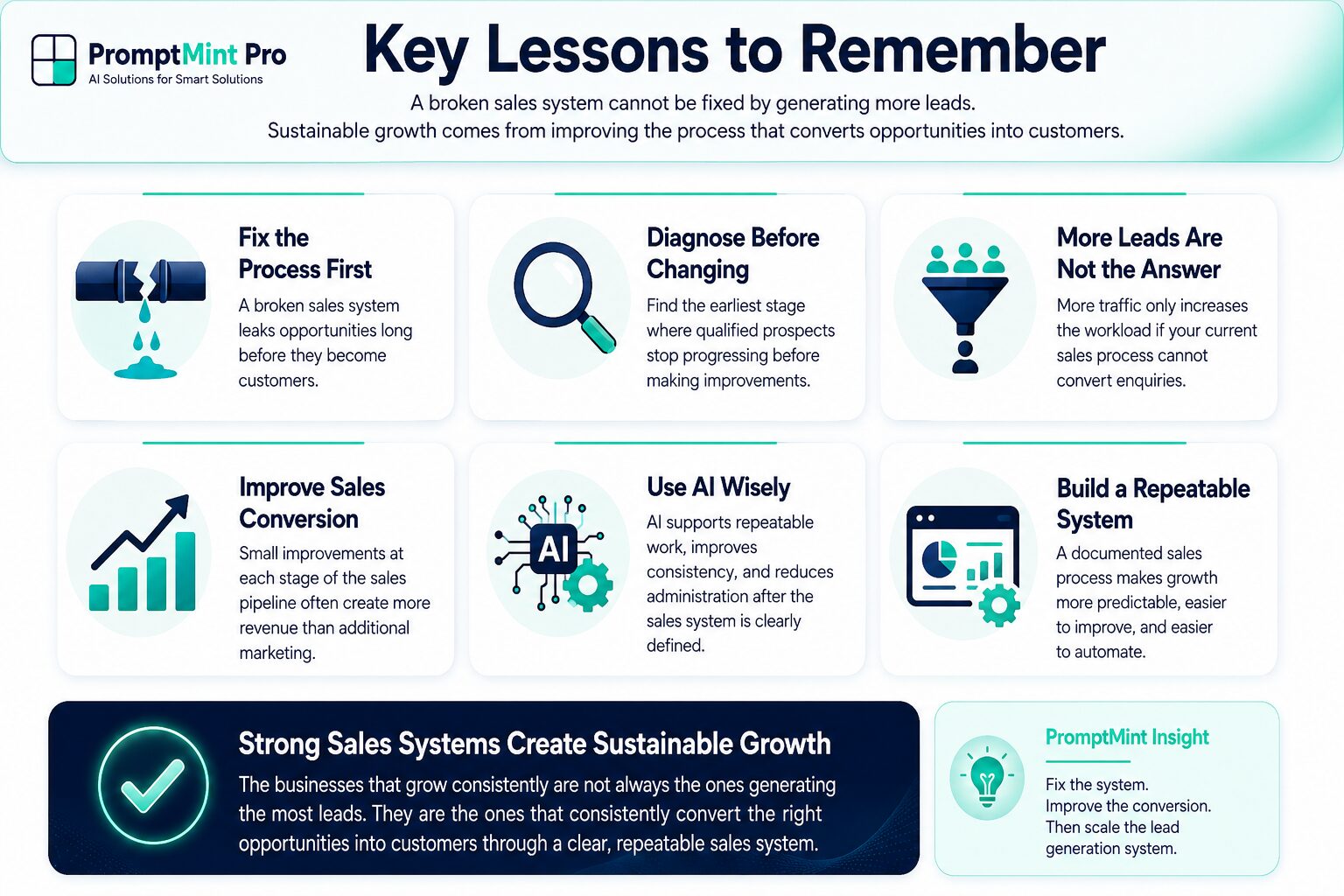
The lessons below bring the article together. They can also serve as a checklist when deciding whether to invest in marketing, sales tools, automation, or a new lead generation system.
A broken sales system leaks opportunities before they become customers. Increasing lead volume only sends more prospects into the same weak process.
Find the earliest meaningful stage where qualified prospects stop progressing before deciding what to improve.
A lead generation system creates opportunities, but it cannot repair weak qualification, slow proposals, or missing follow-up.
Small improvements between enquiry, qualification, proposal, follow-up, and closing can produce more revenue from the leads you already have.
AI works best when it supports a clear workflow. It can reduce administration and improve consistency, but it cannot replace judgment.
A documented sales process is easier to measure, improve, delegate, and eventually automate without losing control.
The Correct Order
Find the real bottleneck.
Fix the weak sales stage.
Create a repeatable process.
Use AI where it genuinely helps.
Increase qualified lead volume.
Free Solopreneur Diagnostic
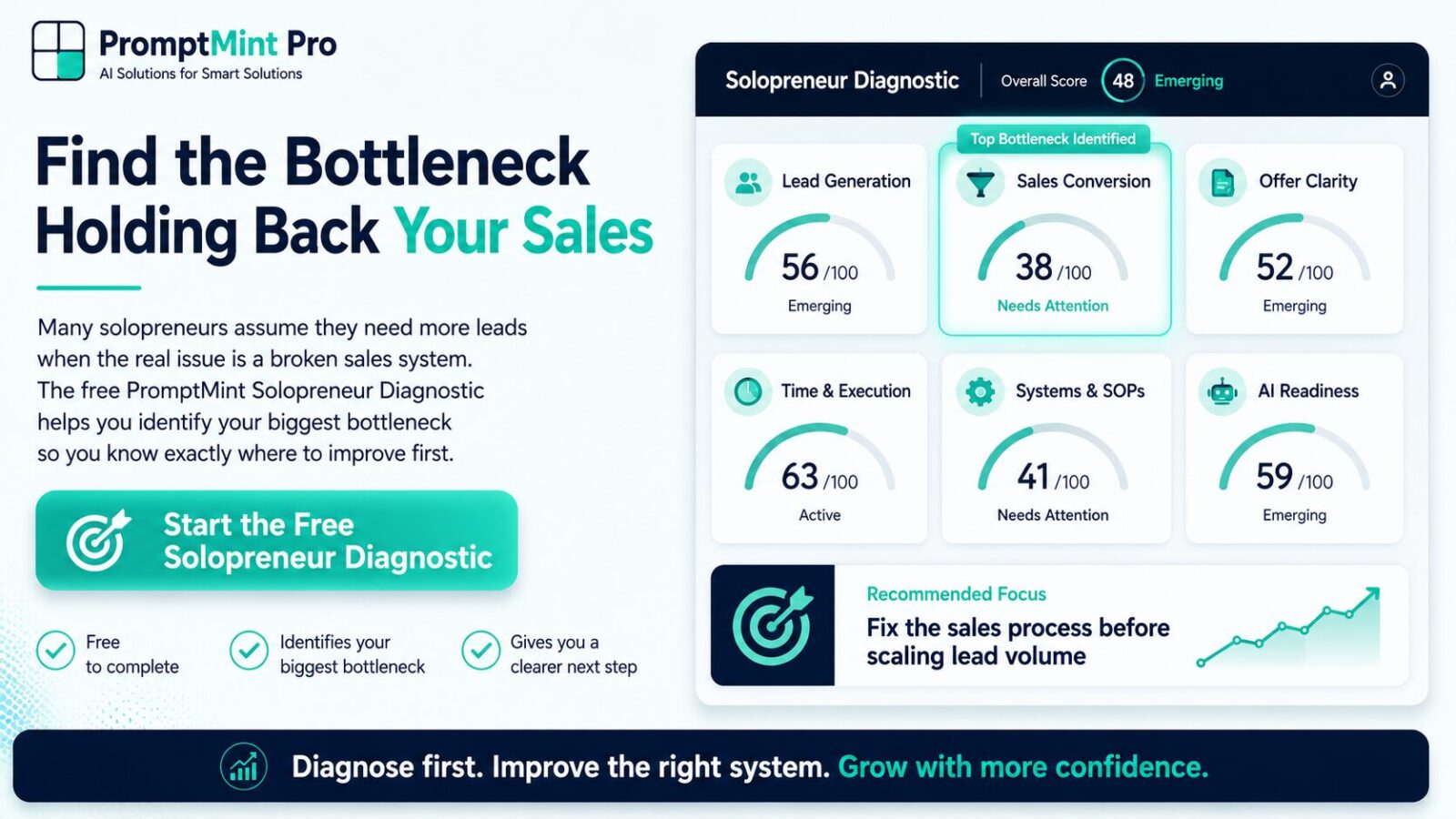
Many solopreneurs assume they need more leads when the real issue is a broken sales system.
The free PromptMint Solopreneur Diagnostic helps you identify your biggest business bottleneck so you can focus on the system that needs attention first.
Diagnose Before You Scale
More traffic will not solve weak qualification, unclear proposals, inconsistent follow-up, or a sales process that depends on memory.
The diagnostic reviews the core systems behind a solopreneur business and helps reveal whether the constraint sits in lead generation, sales conversion, offer clarity, execution, operations, or AI readiness.
Free to complete
Identifies your biggest bottleneck
Gives you a clearer next step
Diagnose first. Improve the right system. Grow with more confidence.