
What it assesses
Review your readiness across eight practical career pillars, including:
- Career direction and employability
- Skills relevance and adaptability
- Network and income resilience
- Job-search and personal readiness
Take a free 32-question self-assessment to see where your career may be most exposed: job stability, AI disruption, income dependence, skills relevance, network strength, job-search readiness, or personal resilience.
You’ll get a practical score, your weakest pillar, a risk profile, and a simple 7-day and 30-day action plan.
Built for professionals, PMETs, managers, freelancers, consultants, and independent workers in Singapore and Malaysia who want to prepare earlier instead of waiting until restructuring, automation, or hiring slowdowns become personal.
No scare tactics. No personality quiz. Just a structured way to see what needs strengthening first.
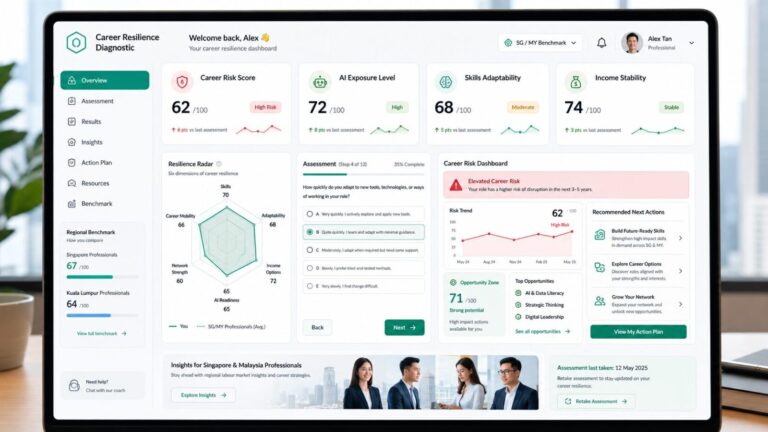
The free Career Resilience Diagnostic™ is a private, 32-question self-assessment that helps you identify the part of your career that needs strengthening before a layoff, restructuring, automation or hiring slowdown forces the decision.
Review your readiness across eight practical career pillars, including:
Your workbook turns general career concern into a clearer starting point.
Complete the diagnostic inside your own Google Sheet copy. Your answers and score stay under your control.
It shows what to strengthen first while you still have time and options—whether that means improving your positioning, updating your skills, rebuilding your network or testing a backup income path.
Free for professionals, PMETs, managers, freelancers, consultants and independent workers in Singapore and Malaysia.
The PromptMint Pro Career Resilience Diagnostic™ is built for professionals in Singapore and Malaysia who want a practical way to assess layoff risk, AI exposure, income dependence, skills relevance, and career optionality. It is especially useful if you are still employed but quietly wondering how prepared you would be if your role changed.
For professionals in Singapore and Malaysia, career stability can no longer be judged only by job title or years of experience. PMETs, managers, support teams, specialists, freelancers, and mid-career workers are all dealing with a more cautious employment market.
The risk is not always sudden retrenchment. Sometimes it looks smaller at first:
These are not dramatic signals on their own. But together, they can show that your career needs stronger backup options.
A career resilience diagnostic is a structured self-assessment that shows how prepared you are for career disruption. It looks at job stability, AI exposure, transferable skills, income resilience, career direction, network strength, job-search readiness, and personal resilience.
It does not predict your future. It helps you see what to strengthen first.
The Career Resilience Diagnostic is designed as a private self-assessment, not a public quiz.
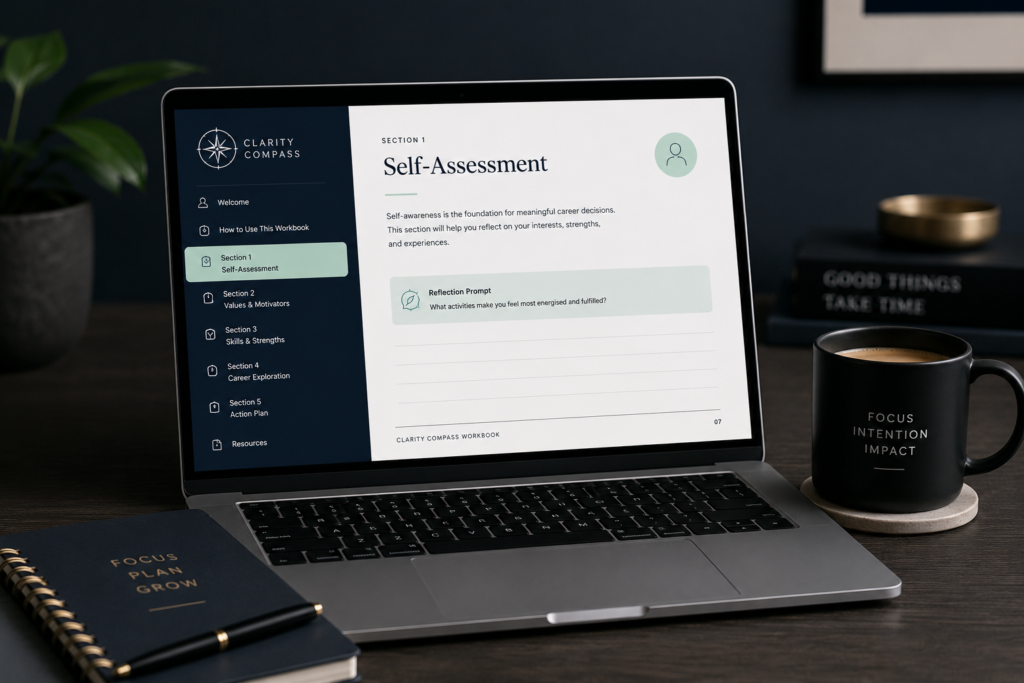
After subscribing, you receive access to a Google Sheet workbook. You make your own copy, complete the 32 questions privately, and review your score inside your own file.
PromptMint Pro does not need to collect your answers or store your score. That is intentional. Career risk, layoff concerns, income dependence, and job-search readiness are personal. The workbook is built so you can assess these areas honestly without sending your results back to us.
After you subscribe, you’ll receive a link to make your own copy of the Career Resilience Diagnostic workbook in Google Sheets.
This gives you a private version of the assessment that you control. You can save it in your own Google Drive, update it later, or download it for your own records.
The diagnostic asks about real career pressure points: job stability, AI exposure, income dependence, skills relevance, network strength, adaptability, job-search readiness, and personal resilience.
Some answers may feel uncomfortable. That is normal. The point is not to look good on paper. The point is to see where your career may be too dependent on one employer, one role, one income source, or one outdated skill set.
Once you complete the questions, the workbook calculates your Career Resilience Score and shows which pillar needs the most attention.
You may find that your job is stable but your income backup is weak. Or your skills are relevant, but your network is too quiet. Or you are employable, but your resume and LinkedIn profile are outdated.
That is the value of the diagnostic. It turns vague concern into something you can actually work on.
The workbook does not stop at the score. It gives you short next steps so you can start strengthening your position.
The 7-day plan helps you act quickly. The 30-day plan helps you keep the work realistic, especially if you are busy, tired, employed full-time, or quietly preparing while still working.
This diagnostic is delivered as a workbook copy because career self-assessment should feel private.
You do not have to submit your answers into a public quiz engine. You do not have to share your score with PromptMint Pro. You can complete the workbook in your own Google Drive and use the results for your own planning.
That matters if you are still employed, worried about layoffs, exploring a pivot quietly, or simply not ready to discuss your next move with anyone yet.
I built the Career Resilience Diagnostic after noticing how quickly work, hiring, AI tools, and career stability were changing.
Layoffs, restructuring, cautious hiring, AI tools, and cost-cutting were no longer abstract headlines. They were becoming part of normal career conversations.
The uncomfortable thought was simple:
“What happens if things change faster than I expected?”
That question became the starting point for this diagnostic.
Not to create panic.
Not to predict anyone’s future.
But to help professionals see where they may need stronger preparation.


Recent reporting from CNA indicates many organizations in Singapore are becoming more selective and conservative with workforce planning amid ongoing economic and technological shifts. The broader environment suggests growing emphasis on adaptable capabilities, continuous upskilling, and flexibility as companies reassess long-term workforce needs.
Source: CNA
Published Date: 09 Jan 2026 (Updated: 23 Jan 2026)
Reporting from The Business Times suggests workforce changes among professionals and managers appear linked more to ongoing business transformation and role evolution rather than widespread replacement by artificial intelligence alone. The broader situation points toward a shifting employment landscape where adaptability and evolving skill relevance are becoming increasingly important.
Source: The Business Times
Published Date: 20 Mar 2026
Coverage compiled by Vulcan Post highlights a growing pattern of workforce reductions across multiple industries in Singapore during 2026, particularly among technology-related and multinational businesses. The broader trend reflects increasing pressure on companies to improve efficiency, reduce operating costs, and adapt to changing economic and technological conditions.
Source: Vulcan Post
Published Date: 13 May 2026
For Singaporean and Malaysian professionals, the Career Resilience Diagnostic gives a simple way to reflect on job stability, AI readiness, and future career flexibility.
Professionals in Singapore and Malaysia are facing a more cautious employment environment. Hiring decisions are becoming more selective, restructuring remains visible across industries, and AI-assisted efficiency is changing how companies think about roles, workflows, and headcount.
The point is not that every job is at risk. The point is that career resilience now depends on more than doing your current job well.
Take the free diagnostic and see where your career resilience may need strengthening.
Your Career Resilience Score is based on eight areas that usually determine how prepared you are when work becomes uncertain.
Some people are highly skilled but weak in visibility. Some have a strong network but depend too much on one employer. Some are employable, but their resume and LinkedIn profile no longer show their real value.
The workbook helps you spot these gaps privately, inside your own Google Sheet copy.

Career direction looks at whether you know where you are heading next. This does not mean you need a perfect five-year plan. It means you have a realistic sense of the roles, industries, services, or income paths that still fit your strengths.
Warning sign:
You know you need a change, but you cannot clearly explain what kind of change makes sense.
Strong indicator:
You can name the next few directions where your experience could still be useful.
Employability is about how easy it is for others to understand your value. A person can have years of experience and still struggle if their achievements sound vague, outdated, or too task-based.
Warning sign:
Your resume mostly lists responsibilities, but does not show clear business results.
Strong indicator:
You can explain what problems you solve, who you solve them for, and why your work matters.
Skills relevance checks whether your current skills still match how work is changing. This is especially important if your role depends heavily on routine admin, manual reporting, repeated customer replies, or process-following tasks.
Warning sign:
A large part of your work can be copied, automated, outsourced, or done faster with AI tools.
Strong indicator:
Your work involves judgment, trust, relationship handling, commercial thinking, analysis, or decisions that still need human context.
Adaptability looks at how well you adjust when tools, teams, job scopes, or market expectations change. This matters because many career risks do not arrive as one big event. They often arrive as small changes that keep stacking up.
Warning sign:
You avoid new tools, new responsibilities, or unfamiliar ways of working until you are forced to use them.
Strong indicator:
You can learn enough to stay useful, even when your role changes around you.
Network strength measures whether opportunities can reach you outside job boards. In a weak job market, cold applications alone can be slow and frustrating.
Warning sign:
Most people in your network do not really know what you do now or what opportunities you are open to.
Strong indicator:
Former colleagues, clients, managers, peers, or industry contacts can remember you for specific work.
Income resilience looks at how dependent you are on one salary, one employer, or one active income source. This is not about becoming a full-time entrepreneur overnight. It is about knowing whether you have options if your main income is interrupted.
Warning sign:
If your salary stopped for three months, you would have no clear backup path beyond job applications.
Strong indicator:
You have savings, monetizable skills, freelance potential, consulting ideas, or another income path you could test.
Job search readiness checks whether you could respond quickly if an opportunity appeared or if your current role became unstable. Many professionals wait until they are under pressure before fixing their resume, LinkedIn profile, portfolio, and interview stories.
Warning sign:
Your career materials do not reflect your latest achievements, tools, projects, or measurable results.
Strong indicator:
You can apply, interview, and explain your value without rebuilding everything from scratch.
Personal resilience looks at your ability to think clearly when your career feels uncertain. This matters because stress can make people freeze, rush into poor decisions, or avoid the hard questions.
Warning sign:
You feel stuck, tired, resentful, or unable to plan beyond the next week.
Strong indicator:
You can face the situation honestly, make a short plan, and take the next useful step.
The 8 career resilience pillars are career direction, employability, skills relevance, adaptability, network strength, income resilience, job search readiness, and personal resilience. Together, they show where your career is strong, where it may be exposed, and what you should strengthen first.
People take this diagnostic for different reasons.
Some are still employed, but they can feel the ground shifting. Others are already in a transition and need to figure out what their experience can still become.
Both situations need honest assessment. But they do not need the same next move.
You may still have a stable title, a regular salary, and no official warning signs. But something feels different.
Maybe your team is being asked to reduce costs. Maybe AI tools are taking over parts of the work. Maybe promotions are slower, hiring is frozen, or your role is becoming harder to explain outside your current company.
This path helps you check your risk before you are forced to react.
If you are already between roles, burned out, underemployed, or thinking about a different path, the question changes.
It is no longer only “Is my job safe?”
It becomes “What can I do with the experience I already have?”
This path helps you examine your transferable skills, income options, and whether your experience could support consulting, freelancing, a service offer, or a more focused job-search strategy.
Because the diagnostic runs inside your own Google Sheet copy, you can complete it quietly. That matters if you are still employed, exploring backup options, or not ready to discuss your next move publicly.
This diagnostic is for people who know something needs attention but may not know where to start.
You might still be employed. You might already be applying for jobs. You might be quietly wondering if your current skills can carry you into another role, industry, consulting offer, or independent path.
The workbook gives you a private way to assess the situation before you make bigger decisions.
A career resilience diagnostic is suitable for professionals who want to assess layoff risk, AI exposure, transferable skills, income resilience, and career optionality. It is especially useful for employed professionals, PMETs, mid-career workers, managers, specialists, and people considering a career pivot or solopreneur path.
For professionals who still have a job but can feel the pressure building.
This may fit you if:
For PMETs, managers, specialists, and experienced workers who are no longer sure their old career plan still works.
This may fit you if:
For people already dealing with career disruption.
This may fit you if:
For professionals who are curious about independent work but do not want fantasy advice.
This may fit you if:
The diagnostic works best when you answer honestly and treat the result as a starting point, not a final verdict.
Because the diagnostic is completed inside your own Google Sheet copy, you can use it privately. You do not need to submit your answers or share your score with PromptMint.
Here is a sample of what your workbook may show after you complete the 32 diagnostic questions.
Your real result depends on your own answers. The workbook calculates your Career Resilience Score, identifies your lowest pillar, shows your risk profile, and points you toward the first area to strengthen.
Your score stays inside your own Google Sheet copy. You do not need to submit your answers or share your result with PromptMint Pro.
| Result Field | Sample Output |
|---|---|
| Career Resilience Score | 96 out of 160 |
| Score Percentage | 60% |
| Score Band | Reactive |
| Lowest Pillar | Income Resilience |
| Primary Risk Profile | Income Concentration Risk |
| Highest Pillar | Network Strength |
| Recommended First Move | Calculate your runway and list 3 income options from existing skills |
In plain English, this result means the person is not in a hopeless position. They have useful strengths, especially in their network. But their income position may be fragile because they depend too heavily on one employer, one salary, or one client source.
That is a common risk. Someone can be experienced, employable, and well-regarded, but still be exposed if their main income stops suddenly.
The first move is not to quit the job or rush into a business idea. The first move is smaller and more practical: calculate financial runway and list three possible income options from skills they already have.
| Score Range | Score Band | What It Means |
|---|---|---|
| 32–64 | Vulnerable | Several areas may need urgent attention. The person may be too dependent on one role, one employer, or outdated positioning. |
| 65–96 | Reactive | Some foundations are working, but the person may still be responding late to career risk instead of preparing early. |
| 97–128 | Stable | The person has a usable career foundation, but one or two weak areas may still create risk. |
| 129–160 | Resilient | The person has stronger positioning, clearer options, and better readiness for disruption or transition. |
A career resilience assessment is a self-evaluation tool that helps professionals understand how prepared they are for workforce uncertainty, layoffs, automation, economic changes, and evolving job market demands. The Career Resilience Diagnostic does this through 32 questions across 8 practical career readiness pillars.
Included resource | What does it help you do |
Profile Setup Sheet | Add your role, industry, country, career stage, and main concern |
32-question diagnostic | Assess your readiness across 8 career resilience pillars |
Auto-scoring summary | See your total score, completion rate, and score band |
Pillar score breakdown | Identify your strongest and weakest areas |
Risk profile output | Understand your biggest career vulnerability |
Results guide | Interpret your score without overthinking it |
7-day action plan | Take immediate action based on your weakest pillar |
30-day strengthening plan | Build better preparation over the next month |
Methodology notes | Understand how the diagnostic works and what it does not claim to do |
Your result will not tell you to quit your job or panic. It helps you see what to strengthen while you still have time, options, and clearer thinking.
Enter your name and email below, and I’ll send you the free workbook.
Because the diagnostic runs inside your own Google Sheet copy, you can complete it quietly. That matters if you are still employed, exploring backup options, or not ready to discuss your next move publicly.


PromptMint Pro is built around one practical belief:
The future may increasingly favor people who can adapt, communicate clearly, learn continuously, use AI responsibly, and build useful systems around their work.
The Career Resilience Diagnostic is one practical starting point for turning that belief into a structured self-assessment.
Career resilience is not about becoming fearless.
It is about becoming better prepared.
A career resilience diagnostic is a structured self-assessment that helps you check how prepared your career is for disruption. It looks at areas such as job stability, AI exposure, income resilience, skills relevance, network strength, job-search readiness, and personal resilience.
The point is not to scare you. It is to show which part of your career may need attention first.
A job may be more exposed if much of the work is repetitive, rules-based, easy to document, or already being handled by software. Examples include routine reporting, standard admin tasks, basic customer replies, manual data entry, and process-following work.
The diagnostic helps you look at this more clearly instead of guessing.
No. It is also useful if you are still employed but quietly concerned.
Many people wait until after a layoff, restructuring, or burnout before reviewing their career position. This workbook is designed to help you check your risk earlier, while you still have time to improve your options.
Yes. The diagnostic is delivered as a Google Sheet workbook copy. You complete the questions in your own file, inside your own Google Drive.
PromptMint does not need to collect your answers, view your score, or store your results. That is intentional because career risk, income concerns, and job-search readiness are personal.
After subscribing, you receive access to the workbook link. You make your own copy, answer the 32 diagnostic questions, and review your Career Resilience Score inside the workbook.
You may also receive follow-up emails that explain how to read your score, understand your weakest pillar, and decide what to work on next.
Most users should be able to complete the diagnostic in about 15 minutes.
You can take longer if you want to think carefully about each answer. Since it is your own workbook copy, you can also return to it later, update your answers, or retake the assessment after making changes.
The score shows your overall career resilience based on the workbook questions. It also helps you understand whether your current position looks vulnerable, reactive, stable, or resilient.
The score is not a prediction. It does not tell you whether you will be laid off. It gives you a clearer starting point for career planning.
Career optionality means having more than one possible path. That could include a stronger job-search position, a clearer industry pivot, consulting potential, freelance income, a small service offer, or skills that transfer into another role.
If all your options depend on one employer, one job title, or one industry, your optionality may be too narrow.
Yes. The Career Resilience Diagnostic can help you check whether you have transferable skills, income resilience, network support, and enough clarity to explore consulting, freelancing, or a small independent offer.
It does not assume solopreneurship is right for everyone. If you want to assess that path more directly, take the PromptMint Solopreneur Diagnostic.
Take the PromptMint Solopreneur Diagnostic
In Singapore and Malaysia, restructuring pressure can show up in manufacturing, customer support, retail, admin, operations, ICT support, and process-heavy roles. But industry alone does not decide your risk.
Two people can work in the same industry and have very different levels of resilience depending on their skills, visibility, network, and income options.
It can help you assess parts of your career that may be exposed to AI, but no assessment can honestly promise to make a job completely “AI-proof.”
A better goal is to understand which parts of your work are repetitive, which parts need human judgment, and which skills may remain useful as AI tools become more common.
No. This is not a personality quiz, and it is not designed to give you a flattering label.
It is a practical workbook-based self-assessment. The questions are designed to help you look at career direction, employability, skills relevance, adaptability, network strength, income resilience, job-search readiness, and personal resilience.
No. No workbook can guarantee job security, income, interviews, or career outcomes.
What it can do is help you see your weak points earlier. That can help you make better decisions about your resume, LinkedIn profile, skills, network, income backup options, and next career move.
Yes. Since you have your own workbook copy, you can retake the diagnostic later.
A practical approach is to retake it every 30 to 90 days, especially after updating your resume, improving your LinkedIn profile, reconnecting with your network, testing a side-income idea, or changing roles.
You do not need to panic.
But it is wise to prepare before pressure forces the decision.
Take the free PromptMint Pro Career Resilience Diagnostic™ and find out which part of your career readiness needs attention first.
We use cookies to improve your experience on our site. By using our site, you consent to cookies.
Manage your cookie preferences below:
Essential cookies enable basic functions and are necessary for the proper function of the website.
These cookies are used for managing login functionality on this website.
Stripe is a payment processing platform that enables businesses to accept online payments securely and efficiently.
Service URL: stripe.com (opens in a new window)
Statistics cookies collect information anonymously. This information helps us understand how visitors use our website.
Google Analytics is a powerful tool that tracks and analyzes website traffic for informed marketing decisions.
Service URL: policies.google.com (opens in a new window)
Google reCAPTCHA helps protect websites from spam and abuse by verifying user interactions through challenges.