
Start with the problem
Describe what is not working without mentioning a product, feature or vendor. A better buying decision begins with diagnosis—not a demonstration.
PromptMint Editorial Series · Issue #001
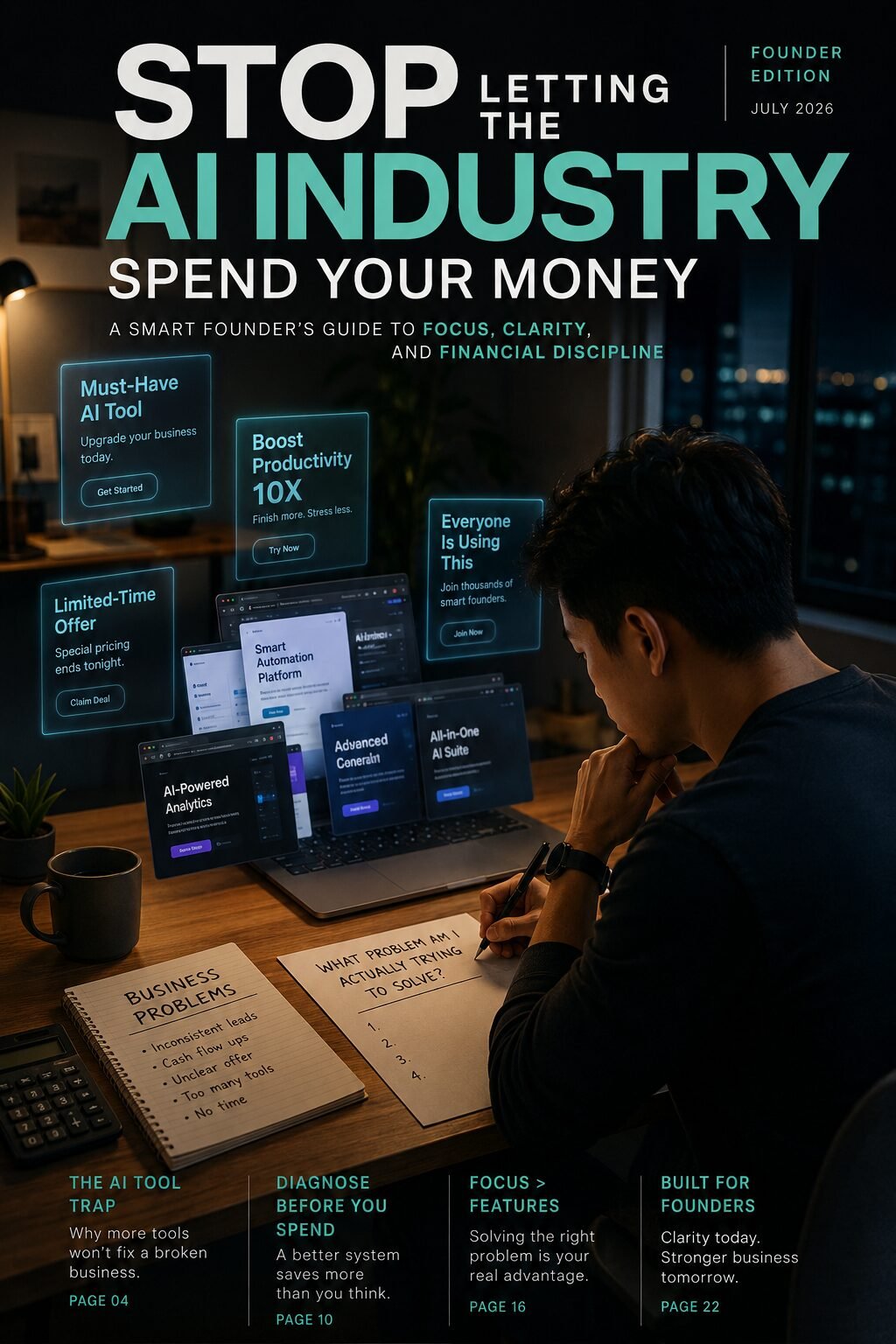
Before you buy another AI tool, make sure you are solving the right business problem—not simply responding to hype, urgency, or someone else's sales pitch.
Every subscription is a decision. Every decision has an opportunity cost.
TL;DR — The short version
An AI tool can be impressive and still be the wrong purchase. Start with the business problem and measurable outcome, then decide whether new software is necessary.
Describe what is not working without mentioning a product, feature or vendor. A better buying decision begins with diagnosis—not a demonstration.
The real cost includes learning, setup, workflow disruption, decision fatigue and time taken away from customers and revenue—not only the monthly fee.
Decide what should improve, what the tool will replace and when you will review the result. More activity does not automatically mean more business value.
If you cannot clearly justify the purchase, wait seven days. Test your current tools, improve the process or gather more evidence before subscribing.
One tool. One primary outcome. One review date. If the tool adds another workflow but removes nothing, pause before buying.
Find the biggest bottleneck in your solo business before adding more software.
You are trying to build a business with limited time and limited money.
You do not have investors funding every experiment. You do not have an IT department researching software, a procurement team comparing vendors, or a large budget that can absorb months of trial and error.
Every subscription comes out of your own pocket. Every purchase is a trade-off. Every hour spent learning the wrong platform is an hour you cannot spend speaking to customers, improving your offer, or generating revenue.
Why does the AI industry market to solopreneurs as if they have unlimited money, unlimited attention, and unlimited time?
Every week, another AI tool launches. Another creator calls it a “game changer.” Another video promises it will save hours, generate leads, automate your business, or replace half your workload.
When you are new to business, it is easy to believe that you are only one subscription away from finally getting ahead.
I know, because I believed it too.
Even a small monthly fee compounds when several subscriptions are added together.
Every new platform creates another interface, workflow, login, and learning curve.
A poor purchase decision costs more when there is no team or budget to absorb it.
A $20 or $50 subscription may look affordable on its own. But the price on the checkout page is only a small part of what a new AI tool will actually cost your business.
The number that makes the purchase feel small, reversible, and easy to justify.
When founders evaluate software, they usually focus on the monthly charge:
“It is only $20 a month.”
“I can cancel anytime.”
“It only needs to save me a few hours.”
Each statement may be true. The problem is that the subscription fee does not include the time required to make the product useful.
After subscribing, you still need to understand the platform, move information into it, create a new workflow, test the outputs, fix mistakes, and decide whether it should replace anything you already use.
If it does not replace an existing tool or remove a meaningful task, it may simply become another system you have to maintain.
The subscription may be cheap. The distraction is not.
As a solopreneur, your scarcest resource is rarely software. It is focused attention. Every new platform must earn the time, money, and mental space it takes from the rest of your business.
AI companies are paid when you subscribe. Affiliates are paid when you click. Creators benefit when a new product gives them something fresh to promote. Your business benefits only if the tool solves the right problem.
Everyone else can win the moment you buy. You win only if the purchase works.
Gains another subscriber, another account, and another recurring payment as soon as you complete checkout.
May earn a commission, referral credit, sponsorship value, traffic, or audience growth from recommending the product.
Still has to learn the product, fit it into a workflow, use it consistently, and produce a measurable business result.
None of this means AI vendors, creators, or affiliates are dishonest. Many recommend excellent products. Many tools genuinely save time, reduce costs, and improve the quality of work.
But the vendor understands its product better than it understands your business.
It does not know whether your real problem is weak positioning, inconsistent lead generation, poor follow-up, an unclear offer, or a workflow that should never have been automated in the first place.
A convincing demonstration proves that a feature works. It does not prove that your business needs it.
The vendor's job is to make the product desirable. Your job is to decide whether the result is necessary.
Do not ask only whether an AI tool is impressive. Ask whether it is important enough to deserve your limited money, time, and attention.
I was not collecting software because I enjoyed paying for subscriptions. I was buying the possibility that the next tool might finally make the business easier.
Every purchase was attached to a problem I genuinely wanted to solve.
I hoped another prospecting platform, outreach assistant, or AI sales tool would create a steady flow of opportunities.
I hoped another writing tool would make content faster, clearer, more persuasive, and more likely to attract customers.
I hoped automation would remove repetitive work and give me more time to focus on decisions that actually moved the business forward.
I hoped the right software would remove doubt and tell me what to do next.
None of those goals were unreasonable. The mistake was assuming that buying another tool was the same as solving the problem.
Each subscription created a short burst of optimism. I would explore the dashboard, watch tutorials, test the features, and imagine how much easier the business might become.
Then normal work returned.
The lead problem was still there. The offer still needed work. The content still lacked a clear strategy. The workflow was still scattered.
The software stack grew. The business problem remained.
Eventually, I realised I was not solving problems anymore.
I was collecting possibilities.
Possibilities feel valuable because they preserve hope. But an unused possibility still consumes money, attention, and mental space.
“What can this AI tool do?”
“What does my business need fixed?”
Before your next subscription, pause long enough to separate the business result you need from the emotional relief the purchase promises.
A product can be impressive, popular, and genuinely useful—and still be the wrong purchase for your business.
What business problem am I actually trying to solve?
That question matters more than the feature list, the free trial, the discount, or the number of people recommending the tool.
Most AI buying decisions begin too late.
Founders often start by comparing products:
Those questions may help you compare vendors. They do not tell you whether you should make the purchase.
The buying decision should begin before the product comparison.
It should begin with the business problem, the current workflow, the desired outcome, and the evidence that a new tool is necessary.
A better buying decision starts with diagnosis—not demonstration.
Do not open another pricing page until you can answer these clearly.
Describe the current problem using facts, not assumptions or vague frustration.
Define the business result you expect to improve, such as revenue, response time, conversion, or hours saved.
Separate symptoms from causes. A lack of leads may actually be a targeting, offer, or follow-up problem.
Consider process changes, clearer priorities, better training, or fuller use of tools you already own.
Decide what proof you need before subscribing: a successful trial, a relevant case study, or a measurable workflow improvement.
If you cannot explain the problem without mentioning the product, you are not ready to evaluate the product.
These questions are not designed to talk you out of using AI. They are designed to stop you from buying the wrong solution for the wrong problem.
Give yourself one point for every question you can answer clearly and with evidence. A vague answer does not count.
You are reacting to interest, urgency, or hype.
You understand part of the decision, but key gaps remain.
You are ready to compare tools, trials, and vendors.
Avoid answers such as “I want to use AI” or “I need to be more productive.” Describe a real business problem in plain language.
I need a better AI writing tool.
Preparing each client proposal takes three hours and delays my follow-up.
Map the current workflow before trying to improve it. Identify the steps, tools, delays, handoffs, and repeated work involved.
Today, this task starts with ______, moves through ______, and is completed when ______.
Check the tools already in your stack. You may be paying for features you have never configured, tested, or learned properly.
Define success before the trial begins. Otherwise, a polished dashboard and interesting features may feel like progress even when the business result remains unchanged.
New software should simplify your operation. If it creates another workflow without removing one, the total complexity may increase.
Before adding a subscription, name what will be cancelled, removed, shortened, or consolidated.
Set a review date and a decision threshold. Do not let a free trial quietly become a permanent subscription without evaluation.
This question exposes artificial urgency. If delaying the purchase for seven days creates no meaningful business risk, you probably have time to investigate properly.
Save the product, leave the checkout page, and revisit the decision after one week. If the need remains clear, continue the evaluation.
It means you have not yet gathered enough evidence to know whether it is right for your business.
The problem, workflow, or desired result is still unclear.
Run a manual test, use an existing tool, or collect more evidence.
Compare vendors using your defined problem and success criteria.
The goal is not to eliminate risk. It is to stop spending money before you understand the decision.
Software can support a good strategy. It cannot replace one. A new AI tool may make work faster, but faster work is only valuable when it moves the business in the right direction.
The problem is not that software feels productive. The problem is that activity and progress can look almost identical from the inside.
You can spend an entire afternoon comparing tools, configuring a new workspace, importing data, and testing prompts. At the end of the day, you may feel as if you have moved the business forward.
But the real test is not how much activity the tool created.
The real test is whether something important changed:
Did the business earn more?
Was meaningful work completed faster?
Did the result become more useful or reliable?
Did the decision become easier to make?
Was a task, tool, or process removed?
Did the customer experience improve?
If the answer is no, the tool may have created output without creating progress.
More output is not automatically more value.
Use this order to prevent tools from defining your priorities.
Describe what is not working in plain business language.
Decide what measurable result should change.
Remove unnecessary steps before adding technology.
Buy only when the role of the software is clear.
A good AI tool helps you execute a decision. It should not be the reason you made the decision.
PromptMint Pro was built around a question the AI market rarely asks: should you buy another tool at all?
Most AI content helps you compare products after the buying decision has already been made.
You are shown feature lists, pricing tiers, demonstrations, templates, integrations, and success stories.
That information can be useful. But it assumes you have already decided that another tool is the answer.
PromptMint Pro starts earlier.
We help solopreneurs examine the business problem, understand the workflow, define the expected outcome, and decide whether AI belongs in the solution.
The goal is not fewer tools for the sake of having fewer tools. The goal is fewer wrong decisions.
Their job is to show why their features are useful and worth paying for.
Their content usually helps buyers choose between products already under consideration.
We help you decide whether the business problem justifies another tool in the first place.
Not enough leads, inconsistent revenue, poor execution, unclear offers, or too much manual work.
Identify what is actually stopping progress instead of assuming the answer is another tool.
Improve the relevant business area using a practical operating process.
Use AI only where it improves a clearly defined workflow and measurable outcome.
PromptMint Pro is not anti-AI. We are anti-random AI adoption.
You do not need to reject AI. You only need to slow the decision down long enough to separate genuine business need from urgency, curiosity, and hope.
Describe the problem without mentioning the product, platform, feature, or vendor you are considering.
Define one measurable result and a date when you will review whether the tool delivered it.
If your answers are unclear, delay the purchase for seven days and investigate the business problem instead.
The AI industry should keep innovating.
Founders should keep experimenting.
But experimentation should begin with a business question—not a checkout page.
Problem before product.
Evidence before urgency.
Outcome before features.
Diagnosis before automation.
Share one tool that genuinely improved a business outcome and one that quietly became another forgotten subscription.
What problem did it solve, and what changed after you started using it?
What convinced you to buy it, and why did it fail to earn its place?
What do you wish you had asked before subscribing?
PromptMint Pro helps service-based solopreneurs identify what is actually holding the business back, prioritise what to fix first, and use AI with greater intention.
AI can be valuable, practical, and worth paying for. But the decision should begin with the business problem—not the promise on the sales page.
Understand what is actually holding the business back before searching for another tool.
A recommendation may be useful, but the seller’s goal and your business goal are not automatically the same.
Decide what must improve, by how much, and by when before you subscribe.
Every new platform should remove complexity, not create another workflow to maintain.
Share this article with someone who may benefit from pausing before their next AI purchase.
PromptMint Pro provides business diagnostics, guided operating systems, and practical AI-assisted workflows across lead flow, revenue stability, offer clarity, content, execution, systems, AI readiness, and founder sustainability.
Editorial note: This article is educational and does not claim that AI tools are unnecessary or ineffective. The purpose is to help founders evaluate purchases based on workflow fit, evidence, expected outcomes, and available resources.
We use cookies to improve your experience on our site. By using our site, you consent to cookies.
Manage your cookie preferences below:
Essential cookies enable basic functions and are necessary for the proper function of the website.
These cookies are used for managing login functionality on this website.
Stripe is a payment processing platform that enables businesses to accept online payments securely and efficiently.
Service URL: stripe.com (opens in a new window)
Statistics cookies collect information anonymously. This information helps us understand how visitors use our website.
Google Analytics is a powerful tool that tracks and analyzes website traffic for informed marketing decisions.
Service URL: policies.google.com (opens in a new window)
Google reCAPTCHA helps protect websites from spam and abuse by verifying user interactions through challenges.